
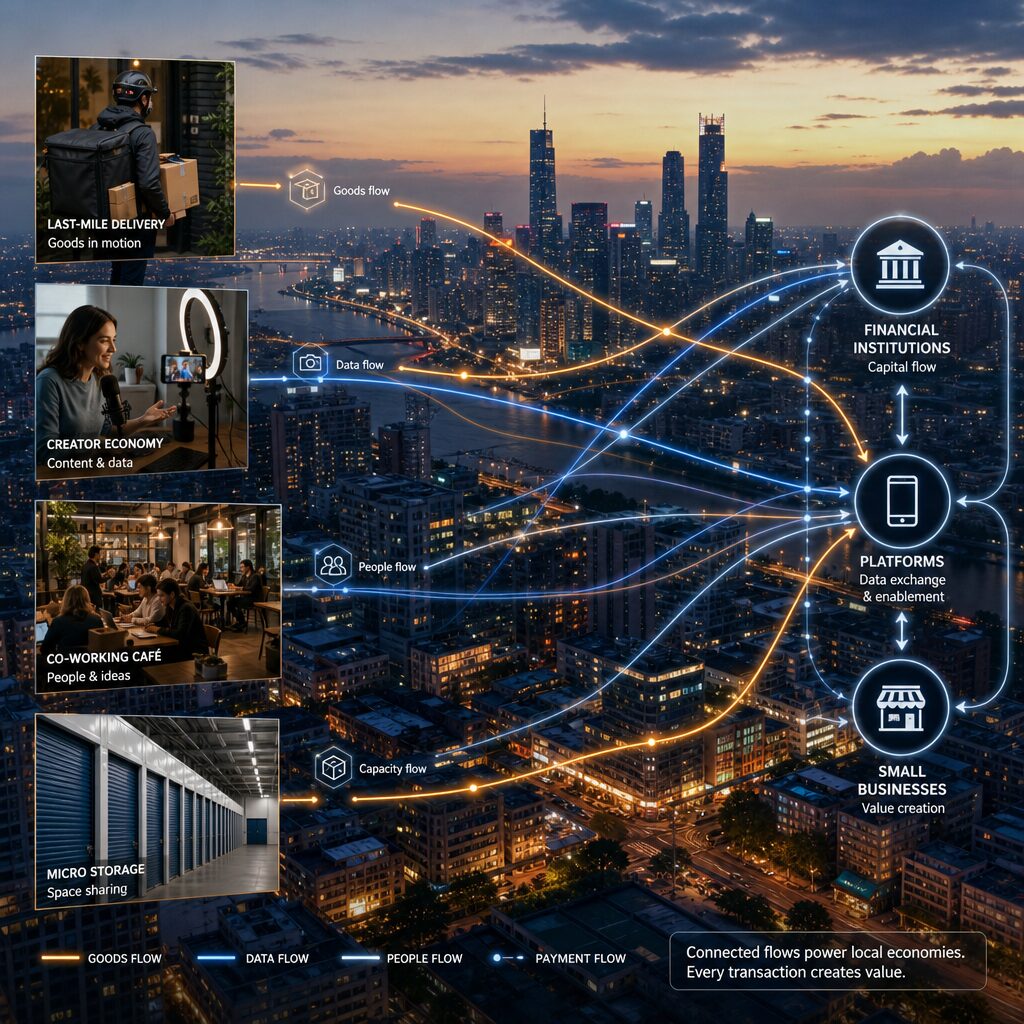
A small ripple, a big pond: framing the 2026 side‑hustle surge
By 2026, side hustles have evolved from occasional gigs into a structural layer of modern labour markets. What starts as an individual effort to top up income — driving, tutoring, creating digital products, or renting out an asset — generates economic ripples that alter demand patterns, firm strategies and market signals. This section frames how tens of millions of micro‑entrepreneurs collectively change the economic landscape: converting disposable hours into flexible supply, creating micro‑enterprises that interact with traditional firms, and redistributing spending power across localities and digital marketplaces.
These ripples are subtle yet cumulative. When thousands of people in a city take on evening freelancing, they change peak demand in restaurants, public transport and entertainment. When creators monetise niche content, they reallocate advertising budgets and attention economies. The key point: side hustles are not peripheral. They rethink how labour, capital and information flow through contemporary economies.
Labour supply elasticity and wage architecture
Side hustles increase the effective elasticity of labour supply, especially among prime‑age workers juggling gig work alongside salaried roles. Firms respond in multiple ways: some compress schedules to retain staff, others outsource non‑core tasks to micro‑contractors. The immediate ripple is downward pressure on wages for commoditised, easily substitutable tasks; the less obvious effect is upward pressure on compensation for roles that demand on‑site presence or specialised skills, as employers bid to secure scarce, non‑fungible labour.
Moreover, a robust side‑hustle ecosystem changes bargaining dynamics. Workers with diversified income streams have greater fallback options, which can reduce immediate wage dependence on any single employer. That bargaining power can translate into higher benefits or more flexible contracts in sectors vulnerable to turnover, while simultaneously encouraging automation where labour becomes fragmented and unpredictable.
SMEs, platforms and the retooling of business models
Small and medium enterprises (SMEs) treat the side‑hustle economy as both competition and a resource. On one hand, platforms that aggregate micro‑services—cleaning, delivery, tutoring—create new competitive pressures on local businesses. On the other hand, SMEs tap the side‑hustle labour pool for on‑demand capacity, reducing fixed labour costs and transforming payroll into variable expense.
Platforms capture much of the value chain: matching, rating and payments. Their fees, data advantages and algorithmic control reshape market entry thresholds. Yet there are counter‑ripples: as more workers build reputations across platforms, a secondary market for “power sellers” and agencies emerges, enabling scale and predictability for firms seeking consistent suppliers. This dual role—disruptor and enabler—forces legacy firms to rethink pricing, supply contracts and customer retention strategies.
Price signals, local economies and real‑estate dynamics
Aggregate side‑hustle income changes spending patterns in measurable ways. Cities with high gig participation often show increased demand for shared workspaces, shorter‑term rentals and flexible logistics services. That demand nudges local rental markets: micro‑rentals and multi‑use spaces become more valuable, while long‑term residential markets may cool in neighbourhoods where short‑term, flexible living is normalised.
Price signals also transmit through consumer services. If many residents earn extra income via delivery or personal services, spending on convenience premium goods rises, incentivising more high‑margin service offerings. Conversely, increased supply of freelance service providers can depress average prices for commoditised tasks, compelling a shift towards experience, quality or bundled offerings to preserve margins.
Capital flows, credit access and entrepreneurial finance
Side hustles increasingly feed into formal financial ecosystems. Micro‑entrepreneurs who monetise online build digital footprints—transaction histories, platform ratings and customer reviews—that lenders and fintechs can use to underwrite micro‑loans. This generates a ripple of credit democratisation: small cashflows become collateral signals, unlocking capital for tool upgrades, inventory and scaling.
However, the pattern is uneven. Platforms often control the most valuable data, creating informational asymmetries that channel finance toward platform‑preferred actors. Traditional banks, slow to incorporate platform signals, risk ceding early‑stage lending to fintechs, altering the competitive architecture of small‑business finance.
Public policy, taxation and regulatory contagion
The growth of side hustles complicates tax bases and regulatory frameworks. Authorities face the choice of integrating micro‑income into withholding systems or maintaining fragmented compliance regimes that encourage informality. Policy ripples include shifts in tax revenue predictability and changes in social insurance design: if side‑hustling becomes the norm, contributory systems for pensions and unemployment must adapt to more variable incomes.
Regulators also contend with platform accountability: labour classification disputes, consumer protection in peer‑to‑peer services, and local planning rules for short‑term rentals. Policy responses in 2026 range from targeted minimal‑reporting thresholds to comprehensive portable benefits schemes. Each approach propagates further market effects—altering platform pricing, labour supply incentives and the cost structures for small businesses.
Innovation Cascades: how side hustles spark new industries
Beyond immediate market adjustments, side hustles are a source of experimental innovation. Micro‑entrepreneurs iterate rapidly, testing niche products and services with low capital. Successful experiments scale into new verticals—specialised creator tooling, micro‑logistics, vertical marketplaces. These innovation cascades produce entrepreneurial clusters that redraw industry maps.
Crucially, the cost of failure in a side‑hustle environment is lower, encouraging risk‑taking. That cultural shift toward iteration and micro‑experimentation increases overall economic dynamism, generating long‑run productivity gains that conventional labour metrics may not immediately capture.
Practical takeaways for business leaders and policymakers
For business leaders: treat side‑hustle ecosystems as both talent markets and distribution channels. Invest in modular procurement, reputation management and partnerships with platforms to harness on‑demand capacity without sacrificing quality control.
For policymakers: design adaptive regulation that captures revenue without stifling experimentation. Use platform data for nuanced tax compliance and consider portable benefits models that align with fragmented earnings. Collaborate with fintechs to broaden credit access while ensuring consumer protections.
For investors: monitor micro‑economic indicators—platform user retention, micro‑loan default rates, local short‑term rental occupancy—as early signals of structural change. The next industry winners will be those that convert micro‑entrepreneurial experimentation into scalable, trust‑based infrastructure.
![Como viver com menos do que você ganha [sem se sentir miserável]](https://productivepathblog.com/wp-content/uploads/2026/05/How-to-Live-Frugally-PTqOcG-559x1024.jpg)
