
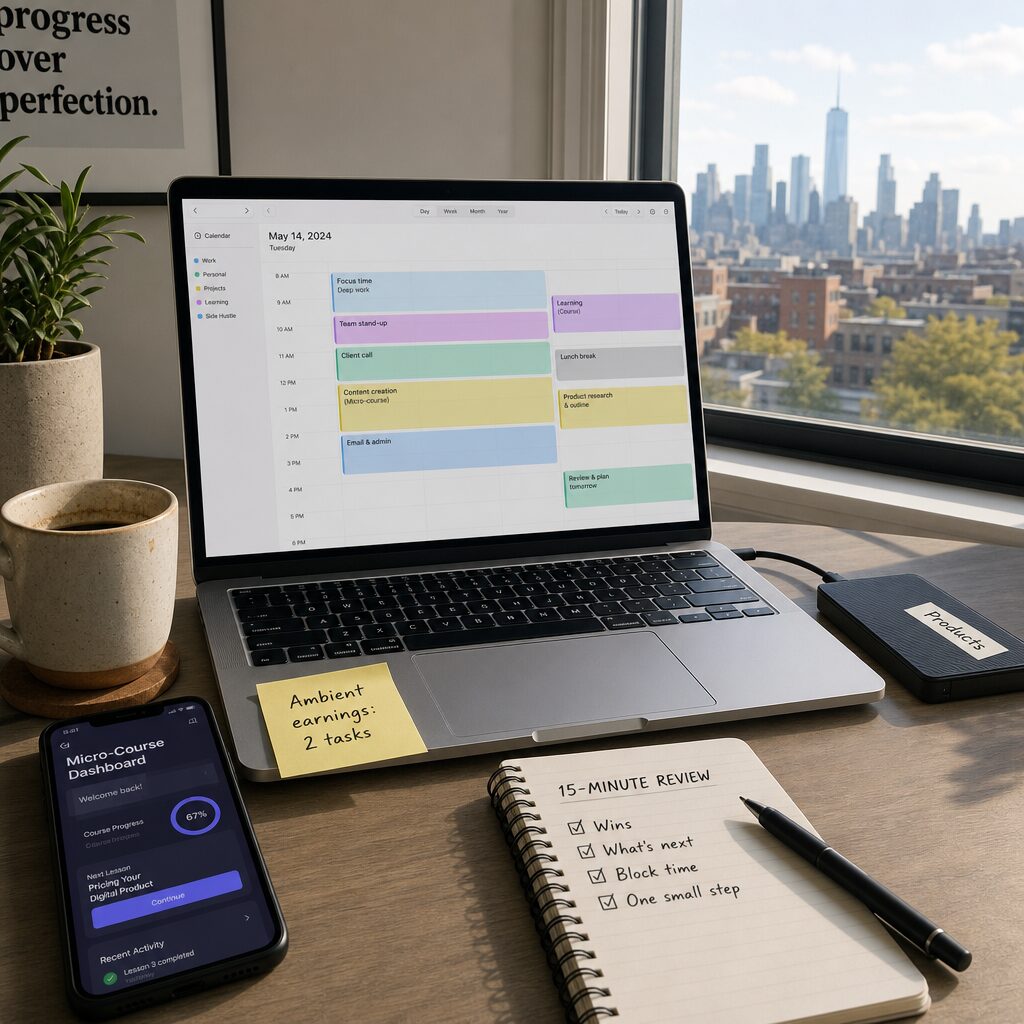
Why Side Hustles Must Live Inside Your Workflow — Not Outside It
The old model of ‘moonlighting’ — late nights and weekend marathons — is brittle in 2026. Modern professionals treat work like a system of flow blocks: discrete, optimised time segments for focused output. The best side hustles now are those that slot into these blocks without demanding a separate identity or dramatic context shift. Rather than carving out a weekend for a second job, the sustainable approach is to design side income streams that are native to your existing rhythm: micro‑consulting in 45‑minute slots, scheduled ‘content batching’ during commutes, or automated digital products that require upfront setup and sporadic maintenance. This reduces start/stop cognitive cost and preserves primary-job performance.
Designing a workflow‑integrated side hustle requires two mindsets: modularity and reflexivity. Modularity means your hustle can be paused, resumed, or handed off without systemic disruption. Reflexivity means the hustle learns from your main work — it uses the same tools, contacts, or expertise and thus benefits from compounding effects. The net result is less burnout, more cumulative value, and greater long‑term viability.
The Rise of ‘Ambient Earning’ — Income that Fits the Gaps
Ambient earning describes revenue that accumulates in the background of everyday life. By 2026, this has evolved from passive indexing to active‑passive hybrids: systems that require tiny periodic inputs but generate persistent returns. Examples include AI‑assisted micro‑courses that update via a weekly 20‑minute audit, subscription newsletters monetised through tiered tools, or curated digital libraries that benefit from algorithmic discovery.
Ambient hustles are designed around friction maps — identifying low‑effort moments (waiting rooms, commutes, treadmill sessions) and assigning microtasks that align with those moments. The goal is not to capitalise on every spare minute, but to create a predictable, low‑stress pipeline that compounds. Measured over months, ambient earnings can eclipse episodic gig income because they scale with consistency rather than intensity.
Workflow‑Native Side Hustles: Four High‑Leverage Models
1) Expert Micro‑Consulting: Short, outcome‑driven sessions (30–60 minutes) that solve a single client pain point. These fit into lunch slots and use the same calendar, video tools and CRM as your day job.
2) Modular Digital Products: Templates, micro‑courses and toolkits that evolve with minimal upkeep. Build once with AI tools and release iterative updates during weekend maintenance sprints.
3) Branded Automation: Small bots or scripts that serve niche communities (e.g. Discord moderation tools, LinkedIn automation for recruiters). Maintenance is reactive, often queued within your normal development schedule.
4) Skill Licensing: License a repeatable process (onboarding frameworks, audit checklists) to firms or creators. It leverages existing knowledge work and converts it into royalty‑like income with periodic review cycles.
Each model shares features: they reuse your primary tools, have low context‑switch costs, and are compatible with time‑boxing strategies.
Tools and Rituals that Make Hustles Seamless
Integrating a side hustle into modern life is as much about rituals as tools. Time‑boxing is central: assign a consistent weekly slot labelled in your calendar as part of your professional system, not as an optional extra. Use lightweight automation — scheduling tools, invoicing apps, AI content assistants — to shave minutes off recurring tasks.
Rituals also protect quality. A 15‑minute weekly review, a single task list for both main job and hustle, and a ‘handover checklist’ for any outsourced components keep the hustle aligned with your broader workflow. The aim is to make the hustle obedient to your life rhythms rather than the other way round.
Cognitive Load and Ethical Boundaries
Side hustles that nest inside your workflow still consume cognitive bandwidth. Tracking mental load is essential: if a hustle increases decision fatigue on high‑priority tasks, it is misaligned. Use simple metrics — interruption count, energy impact (subjective), and number of context switches — to decide whether to scale, pause or delegate.
Ethics matter more in integrated models because conflicts of interest can be subtle. Transparent boundaries with employers, clear client terms and a willingness to pause activities that create perceived conflicts will preserve reputation and sanity. Integration should mean harmony, not entanglement.
Case Studies: Real‑World Fits for Different Lifestyles
A day job manager with a family: chooses modular digital products. She records two‑hour content sprints on Saturdays, then uses 30‑minute weekday slots for customer support — a fit with childcare rhythms.
A location‑agile freelancer: builds branded automation tools. Development happens during travel downtimes; revenue arrives through subscriptions and enterprise licensing.
A corporate analyst: offers expert micro‑consulting to niche startups. Short, paid strategy calls scheduled around existing meetings create high hourly value with limited overhead.
These examples show that the same principle — designing the hustle to fit the life pattern — produces different tactics depending on responsibilities and energy cycles.
A Six‑Week Playbook to Embed a Side Hustle into Your Workflow
Week 1 — Audit: Map your weekly flow blocks, energy peaks, and low‑effort windows. Identify one niche that matches your expertise and time topology.
Week 2 — Prototype: Build a minimum viable product (MVP) that requires one automated or scheduled input per week. Price it to favour early adoption.
Week 3–4 — Integrate: Slot promotion, fulfilment and maintenance into existing tools and calendar slots. Introduce a 15‑minute weekly ritual for review.
Week 5 — Scale or Delegate: Use income signals to decide whether to automate more or hire part‑time help. Track cognitive load metrics.
Week 6 — Consolidate: Formalise client terms, establish ethical boundaries and plan quarterly updates. If it fits your life without harming core responsibilities, scale progressively.
The Long View: Compounding Value Over Time
When side hustles live inside your workflow, they stop being episodic projects and become accretive systems. Knowledge, networks and tools from the hustle feed back into your main work, and vice versa, creating a compounding loop. Over years, this produces asymmetric returns: a modest monthly stream that grows with credibility and automation rather than a single large payoff that fades.
The organising principle for 2026 is not hustle harder but design better — choose side income that respects your attention, reuses your assets, and fits the rhythm of your life.
![Como viver com menos do que você ganha [sem se sentir miserável]](https://productivepathblog.com/wp-content/uploads/2026/05/How-to-Live-Frugally-PTqOcG-559x1024.jpg)
