
A different question: why 2026’s side hustle market feels like a tech renaissance with human glue
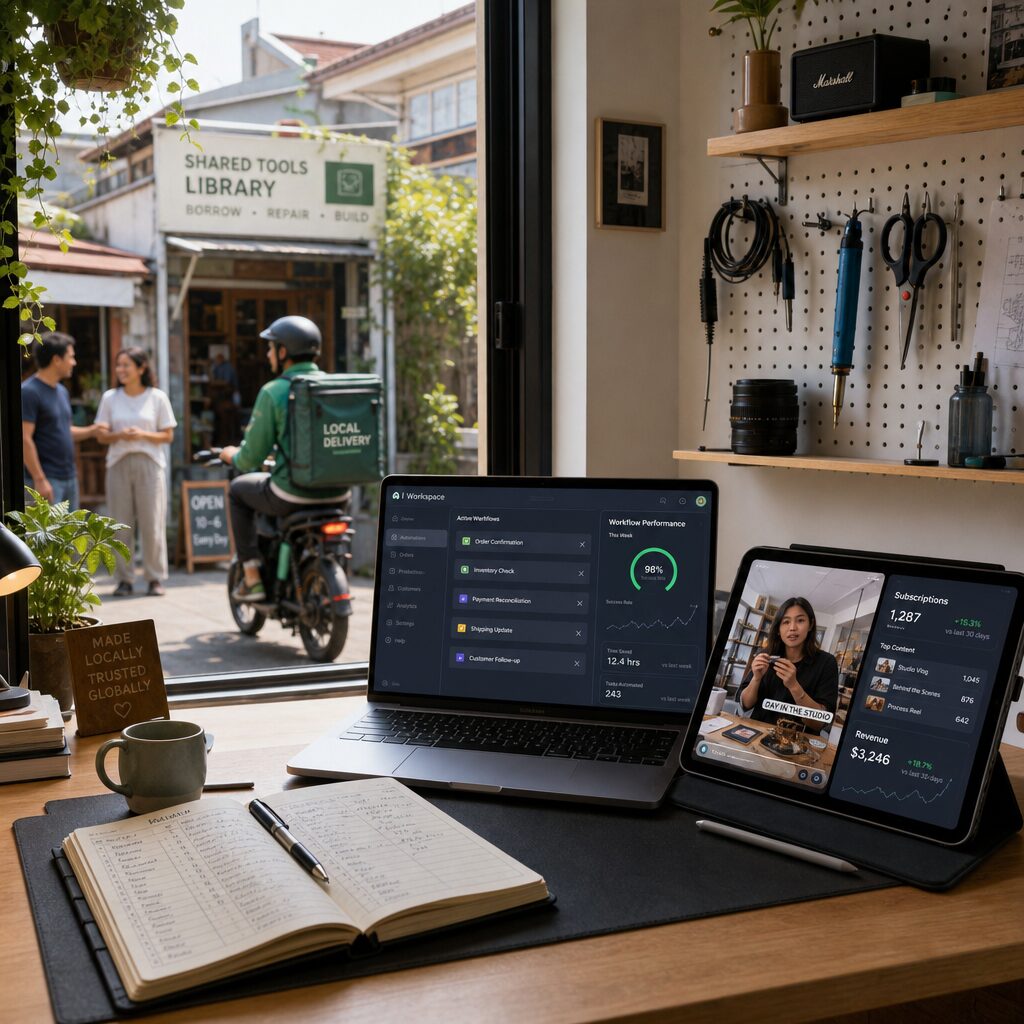
Most articles list gig ideas; this one asks why certain hustles win now. In 2026 we’re not just seeing new ways to earn — we’re witnessing structural shifts that favour specific, repeatable, small-scale businesses. Two forces dominate: powerful AI that automates cognitive labour, and a cultural reaction that prizes authenticity, locality and bespoke services where machines alone fall short. That tension — machine capability plus human differentiation — is the defining trend shaping the most lucrative side hustles today.
Think of the current market as a layered ecosystem. At the base, commoditised tasks are being absorbed by AI and platform automation. Above that, opportunities cluster where humans provide curation, context, or trust. The result: the most resilient side hustles are hybrids — microservices amplified by AI, distributed via new platform economics, and rooted in credibility or locality that can’t be fully automated.
Trend 1 — AI augmentation creates micro-specialist services
Large language models and multimodal AI have transformed what one person can offer. Instead of offering generic copywriting, successful micro-businesses specialise around tightly defined outcomes: productised pitch decks for seed rounds in a niche, personalised micro-courses for professional CE credits, or AI-assisted legal summaries for freelance creatives.
Why this matters: AI lowers the time cost per deliverable, meaning a single operator can scale to dozens of clients without hiring. The premium goes to those who can package expertise into repeatable workflows and add interpretive judgement or empathy. Examples emerging in 2026 include ‘AI-assisted wardrobe consultants’ who combine body-scanning apps with a personal style narrative and local tailoring referrals, and ‘micro-UX audits’ for indie apps that use automated heuristics plus human prioritisation.
Trend 2 — Platforms are fragmenting: subscription micro-economies beat one-off gigs
After years of single-ticket marketplaces, the dominant business model for side hustles has shifted to recurring relationships. Micro-subscriptions — monthly coaching cohorts, curated digital libraries, reuse licences for design assets — provide predictable income and higher lifetime value.
New platforms facilitate this: membership-first marketplaces, creator co-ops with shared payment rails, and decentralised reputation systems that reward repeat business. For side hustlers this means the smartest play is converting transactional services into habitual ones: a freelance illustrator might pivot from one-off commissions to a tiered asset pack club; a language tutor might move from hourly lessons to a micro-credential pathway with cohort support.
Trend 3 — Creator economy 2.0: attention is modular and shippable
Creators no longer monetise raw attention alone. Instead, attention is being modularised into shippable products: micro-certificates, licensed short-form courses, interactive templates and community cohorts. Platforms now support fractional ownership of IP — patrons buy rights to repurpose content under controlled licences. This unlocks income streams that sit between donations and full commerce.
For side hustlers: build modular outputs (templates, scripts, playlists, mini-courses) that can be sold, licensed or resold. Use short-form video and adaptive learning tools to reduce friction: a 6-lesson micro-course consumable in commutes can outsell a 12-hour traditional course. The advantage goes to those who design content as a product rather than as ephemeral posts.
Trend 4 — Localised, high-trust services rebound as digital fatigue grows
Paradoxically, as digital tools proliferate, demand for local, high-trust human services has strengthened. People monetise proximity and trust: repair-as-a-service for durable goods, in-person micro-workshops, boutique senior-tech support, and hyper-local delivery/concierge offerings. These hustles benefit from low competition and high margins because they solve friction that remote automation cannot.
Practically, this trend favours operators who combine online reach with offline fulfilment: scheduling, digital payment and automated communication streamline operations, while the human touch — repair skill, local knowledge, empathy — becomes the differentiator.
Trend 5 — Financialisation of micro-entrepreneurship: tokenisation, revenue shares and fractional ownership
New finance primitives let side hustlers raise small amounts of capital, fractionalise future revenue, or sell stakes in repeatable micro-businesses. Platforms now support revenue-share storefronts, micro-investor syndicates for content IP, and token-based memberships that confer earnings and governance rights. This trend changes risk profiles: a creator can pre-sell rights to a course series, while a neighbourhood repair co-op can crowdfund a shared tool library.
The consequence is twofold: more people can bootstrap scalable side hustles, and buyers/investors gain exposure to diversified micro-enterprises. For ambitious side hustlers, understanding simple legal structures and transparent revenue sharing is becoming essential.
How to choose the right trend for your skills (practical filter)
Use a three-question filter to pick a 2026-ready side hustle:
1) Automate or augment? Identify parts of your service that AI can handle and parts that need human judgement. Productise the automatable parts.
2) Repeatability vs one-off: Can you convert this into a recurring offer or a modular product? If yes, prioritise subscription or licence models.
3) Trust & locality: Does the service rely on trust or physical presence? If so, emphasise high-touch onboarding and local partnerships.
A quick application: if you’re a photographer, automate editing with AI pipelines, sell monthly asset packs to niche creators, and offer premium in-person branding shoots locally. If you’re a developer, build a subscription-based micro-SaaS for a narrow vertical and offer consultancy retainer spots for custom integrations.
Tools, platforms and small bets to make this year
Practical starting points that embody these trends:
– AI workflow tools: invest time in prompt engineering and chain-of-thought templates that let you deliver outputs faster.
– Membership-first marketplaces: migrate clients to a simple subscription or patronage model.
– Licence-first distribution: package repeatable outputs as licences rather than single sales.
– Local partnerships: join or create co-ops to share tools, referrals and pooled advertising.
– Simple finance primitives: use revenue-share platforms or micro-crowdfunding for pre-selling projects.
Small bets matter: validate a recurring offer with ten paying customers before expanding. Focus on repeatability, trust and modular outputs rather than chasing the next shiny gig type.
Final thought — design your side hustle as a resilient system, not a job
The most successful 2026 side hustles are engineered systems: a repeatable delivery process, an engine for customer acquisition, and a balance between automation and human differentiation. Follow the trends — AI augmentation, subscription micro-economies, modular creators, local trust and micro-finance — but combine them into a single, scalable system. That synthesis, rather than any one trendy hustle, is what will create reliable extra income for the coming years.
![Como viver com menos do que você ganha [sem se sentir miserável]](https://productivepathblog.com/wp-content/uploads/2026/05/How-to-Live-Frugally-PTqOcG-559x1024.jpg)
