
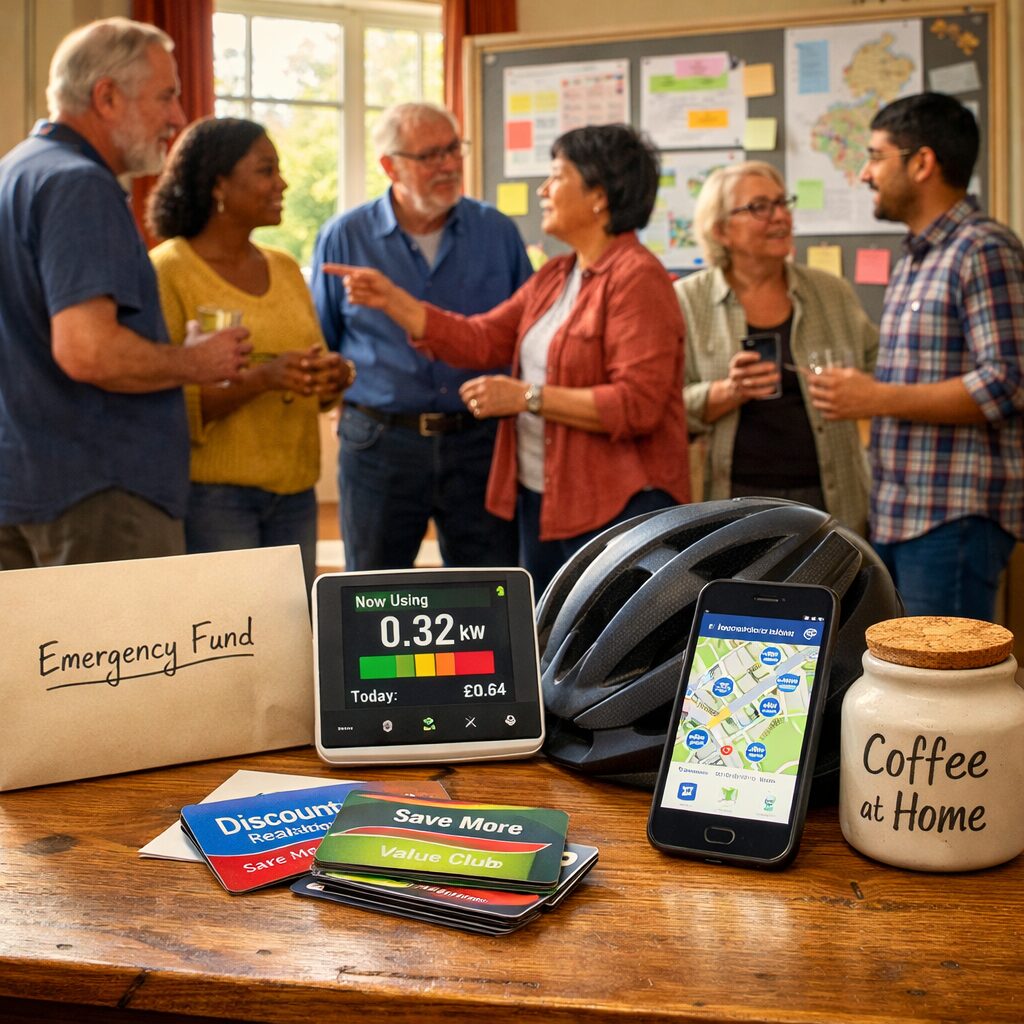
Why saving is now a civic act, not just a personal habit
Most advice columns treat saving as a private ledger exercise: transfer X to a savings account, cancel the gym membership you never use, brew coffee at home. That’s useful, but it misses a wider truth. In an era of compressed wages, fragile supply chains and intermittent inflationary shocks, every pound you save becomes a unit of civic resilience. When households build predictable buffers, communities weather crises — from unexpected medical bills to regional energy price spikes — with less strain on public services and fewer cascading failures in local economies.
Framing saving as a civic act changes the moral grammar. It shifts the conversation from scarcity-induced shame to collective prudence and mutual security. The ten smart ways to save money every month, when widely adopted, reduce systemic risk. This is why the act of saving matters more than most people realise: it’s not just about your bank balance, it’s about the stability of the systems you depend on.
Behavioural currency: how small regular habits reshape decision-making
The power of monthly savings lies in habit architecture. Each regular small saving rewires decision-making pathways in the brain. Choosing to cancel a subscription, negotiate a bill or meal-plan once a month creates a compound behavioural effect: you start to expect leverage over recurring costs. That expectation spills into other domains — better negotiation with employers, more intentional consumer choices, smarter investment of time.
This behavioural currency has social spillovers. Habitual savers are likelier to participate in community lending circles, volunteer for financial education and advocate for local policy changes. In short, monthly saving habits cultivate agency. The ten practical methods that make up these habits are therefore more valuable than a single large windfall because they produce durable psychological and social returns.
Saving as climate resilience and resource optimisation
Many monthly savings strategies — energy efficiency, reduced waste, shared mobility — double as climate-smart behaviours. Turning down the thermostat, insulating a home, cooking in bulk or joining a car club not only reduces household expenditure but also lowers carbon emissions. When millions of households adopt these practices incrementally, the aggregate effect is substantial.
This intersection explains why the ten ways to save money matter beyond personal finance. They create demand for sustainable services, stimulate markets for retrofit technologies and reduce peak load pressures on energy grids. In other words, small household actions become levers for decarbonisation and resource optimisation at scale.
Data literacy: why monthly savings teach you to read the modern economy
We live in a data-rich marketplace where prices, subscriptions and loyalty schemes shift constantly. Regularly tracking and trimming monthly expenses forces people to engage with the data economy: reading terms and conditions, comparing unit prices, parsing usage analytics. These micro-skills are transferable to broader financial decisions like mortgages, pensions and entrepreneurship.
The ten smart methods to save each month therefore function as an accessible curriculum in economic literacy. They teach pattern recognition — identifying where small leakages turn into large losses — and provide the confidence to interrogate larger, more complex financial decisions. In short, monthly saving is an educational vehicle for navigating a digitised economy.
Equity and the hidden regressive effects of ignoring monthly savings
Ignoring the value of modest, recurring savings tends to hurt those with least slack. A family on a tight budget cannot absorb sudden expenses; they pay higher effective interest via predatory credit and missed discounts. By contrast, even modest monthly savings change eligibility and bargaining power: eligibility for cheaper insurance tiers, access to affordable credit, or a security deposit for better housing.
The ten ways to save monthly are therefore tools of redistribution when widely adopted and supported by policy. Targeted programmes that help low-income households implement these strategies — energy-efficiency grants, community bulk-buy schemes, financial coaching — multiply their impact. Recognising this reframes saving from a neoliberal moral duty to a lever for social justice.
Technology and the ethics of automation in saving
Automation makes it easier to save, but it also raises ethical questions. Round-up apps, algorithmic budgeting and subscription managers can help people accrue small amounts without active effort. Yet they can also obscure fees, normalise surveillance of spending habits, and shift responsibility away from systemic fixes to individual adjustment.
Understanding the ten ways to save monthly in 2026 requires a critical stance toward fintech: embrace tools that increase transparency and control, reject ones that monetise attention or hide costs. Advocacy for open standards and consumer protections is part of why these ten methods matter: the way we automate savings today shapes financial autonomy tomorrow.
Collective experiments: how communities scale the ten small changes
The macro-power of monthly savings appears when communities run coordinated experiments. Local councils, housing co‑ops, faith groups and businesses can pilot interventions — communal bulk purchases, neighbourhood tool libraries, time-banking systems — that make each of the ten smart saving techniques more effective and equitable.
These experiments produce replicable models. When a council uses energy-bill data to target insulation grants and shows reduced arrears, the case study accelerates wider adoption. Viewed this way, the ten ways to save are not merely personal hacks but building blocks for community policy innovation.
A synthesis: thinking beyond the list to systemic design
The original list of ten smart ways to save money every month becomes transformative only when we see it as a systems design problem. Each tip is a node in a network of behaviour, infrastructure, technology and policy. Alone, a cancelled subscription saves a few pounds. Combined with better billing transparency, supportive community programmes and ethical fintech, that action contributes to resilience, equity and sustainability.
So the real claim is this: the ten approaches matter more than people realise because they are entry points into systemic change. Treat them as seeds for civic conversation, not merely items to tick off a to-do list.
Practical next steps: how to turn recognition into action
Start locally. Share one saving tactic with your neighbours and ask what barriers they face. Use a transparent budgeting tool and invite feedback. Advocate for one policy change — a local bulk-buy scheme, a grant for insulation, or clearer subscription billing — and gather signatures or support.
Small collective experiments scale. Document outcomes, publish results (for example on community portals) and encourage local authorities to replicate successes. That way, the ten smart ways to save monthly become a catalytic practice for more resilient, equitable and sustainable communities.
![Como viver com menos do que você ganha [sem se sentir miserável]](https://productivepathblog.com/wp-content/uploads/2026/05/How-to-Live-Frugally-PTqOcG-559x1024.jpg)
