
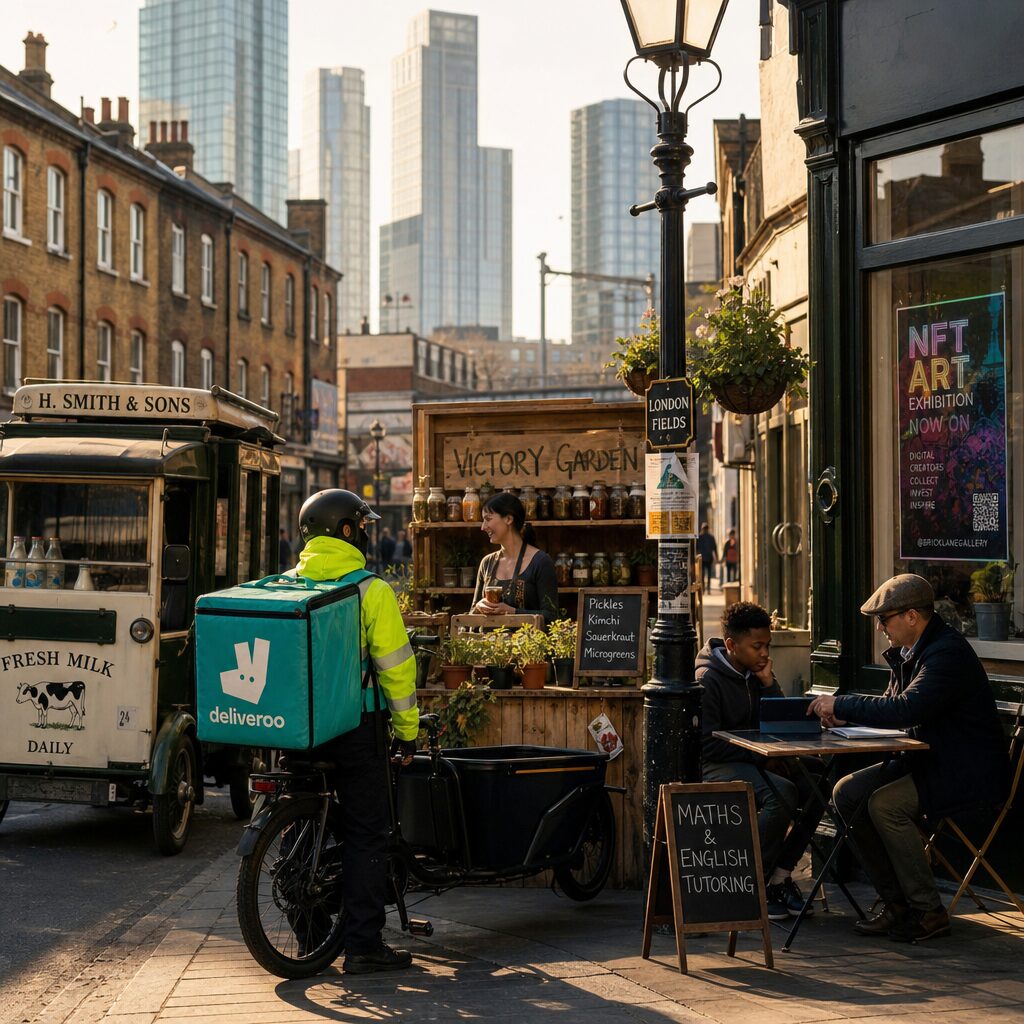
Introduction: Why the Past Explains 2026’s Side Hustles
In 2026, when people talk about side hustles they often picture slick apps, AI agents and creator platforms. What they rarely do is see these opportunities as the latest act in a centuries‑long drama about how people secure extra income when formal jobs fall short. This piece traces surprising lineages—how victory gardens turned into urban farms, milk rounds evolved into on‑demand delivery, and telegraph networks foreshadowed today’s remote freelance marketplaces. Understanding these origins reveals patterns that can help you pick a side hustle with staying power instead of chasing every new fad.
The history of side work is not a straight line. It’s a series of reinventions driven by technology, social norms and regulation. By following the genealogies of the most prominent 2026 hustles, we can see that many so‑called innovations are adaptations of older survival strategies. This perspective reframes side hustles as social technologies with deep roots rather than as purely digital novelties.
Archaeology of Side Work: Old Professions, New Names
Micro‑entrepreneurship has existed as long as markets. A 19th‑century seamstress taking in work at home is genealogically identical to a today’s Etsy seller: both monetize specialised skills from a flexible base. Likewise, the gig economy’s delivery drivers echo the milkmen, coal sellers and newspaper hawkers whose rounds sustained households before supermarkets and couriers centralised logistics.
Consider tutoring. Its modern incarnation—tutoring platforms, micro‑lessons on video—descends directly from the travelling pedagogue and the one‑room schoolmaster offering extra lessons for coin. The persistence of demand for personalised instruction across centuries explains why online tutoring remains one of the most resilient side hustles: it satisfies a human need that technology merely reshapes, not invents.
Even brand‑new‑seeming categories have surprising precedents. The creator economy’s patronage model mirrors medieval guilds’ commissions and Renaissance patronage: creators historically traded exclusive access and bespoke work for direct support. What’s new in 2026 is scalability. Digital tools compress distribution and payments, but the fundamental social contract—audience support in exchange for value—has been around for a very long time.
The Tech Ancestry: From Telegraphs to Models
Many modern side hustles trace their DNA to communications and transportation revolutions. The telegraph standardised distant exchanges and created a labour market for remote information—early ancestors of today’s remote freelance marketplaces. Radio and television created celebrity economies; social media amplified that pattern into the creator funnels we see on platforms that monetise attention.
Mechanical Turk, Amazon’s early microtask platform, is itself a name with historical irony. The original ‘Mechanical Turk’ was an 18th‑century chess automaton that concealed human labour. The 21st‑century platform similarly hides distributed human work behind an API. This lineage highlights a recurring trade‑off: technological convenience often masks labour that remains human, available for micro‑payment. In 2026, AI models have automated some tasks, but they’ve also spawned new microjobs—prompt engineering, model auditing and human‑in‑the‑loop verification—continuing the hidden‑labour tradition in novel forms.
Blockchain and crypto side hustles carry a different pedigree: the cypherpunk and open‑source movements. Early digital communities experimented with decentralised value transfer and voluntary contribution long before mainstream adoption. NFTs, tokenised memberships and decentralised marketplaces in 2026 are socially comparable to nineteenth‑century co‑operatives that pooled resources and distributed surplus—digital co‑ops with programmable rules instead of ink and ledger books.
Cultural and Demographic Roots: Who Invents Side Hustles?
Side hustles often emerge where people face labour market exclusion or economic pressure. Immigrant communities have long been incubators for small enterprises, from street food to micro‑retail, because they leverage social networks, language skills and adaptability. The gig economy’s early adopters were frequently migrants and students—groups with flexible labour supply and a need for additional income.
Women have also driven innovation in side work. Historical patterns show women creating home‑based economies—sewing, teaching, food production—when formal employment opportunities were limited. Today’s platforms have repackaged those activities: handmade goods, online courses, virtual assistance. Recognising these continuities highlights an important truth: many side hustles are social adaptations to structural labour constraints, reshaped by technology and policy rather than completely new inventions.
Cultural capital matters too. Crafts, professional services and niche expertise convert into side income when communities value them. Thus, local history and cultural tastes shape which hustles thrive. In 2026, regional variations remain pronounced: micro‑farming flourishes in post‑industrial cities with strong local food movements, while code‑related side hustles concentrate near tech hubs and remote clusters.
Regulation, Finance and the Long Arc of Legitimacy
The regulatory story behind side hustles is often overlooked but crucial. Many activities begin in legal grey zones—couriers operating outside taxi licences, short‑term lets preceding zoning rules, crypto marketplaces ahead of financial oversight. Over time, some hustles become institutionalised: laundrettes, taxis and bed‑and‑breakfasts were once informal market responses that became regulated industries.
Finance follows: microcredit programmes of the 20th century, post‑war credit expansion and digital payment rails each opened new possibilities for side incomes. Today’s fintech tools—instant settlement, embedded payments and micro‑loans—are the latest chapter. They make it easier to scale small ventures, but history warns that access to capital and the evolution of rules decide which hustles survive and which are squeezed out.
Understanding this legal and financial genealogy helps explain why certain 2026 hustles are scalable and why others remain ephemeral. The ones most likely to last have historically proven adaptable to regulation and able to access formal financial instruments.
Lessons from the Past: Choosing a Side Hustle with Staying Power
If history is a guide, pick hustles anchored in persistent human needs: food, learning, convenience and trust. Those categories have weathered technological change because they solve recurring problems. Hustles built on ephemeral trends—viral formats, speculative assets—can spike fast but collapse faster.
Look for a heritage: does the hustle have an antecedent that existed before the current technology? If so, it’s likely solving a real demand. For example, peer‑to‑peer delivery is a modern expression of local logistics networks; online tutoring reflects longstanding personalised pedagogy; neighbourhood‑based micro‑farming revives victory‑garden pragmatism for urban food insecurity. Use history as a filter to distinguish longevity from hype.
Finally, consider adaptability. The most resilient side hustles in history were those that could be formalised, regulated and financed when necessary. Build with compliance, diversify income streams, and see platform tools as accelerants rather than foundations. That approach trades short‑term glamour for durable earnings.
Conclusion: The Next Wave Will Be Old at Heart
2026’s side hustles look futuristic because of AI, Web3 and instant-on platforms, but beneath the surface they’re familiar reinventions. By excavating the surprising origins of today’s options, we see repetition—technology reframes age‑old strategies for making extra income. Understanding these genealogies doesn’t just satisfy curiosity. It gives practical insight: choose hustles that address enduring needs, adapt to regulation and leverage community knowledge. In short, the best new side hustles are often the oldest ideas dressed for tomorrow.
![Como viver com menos do que você ganha [sem se sentir miserável]](https://productivepathblog.com/wp-content/uploads/2026/05/How-to-Live-Frugally-PTqOcG-559x1024.jpg)
