
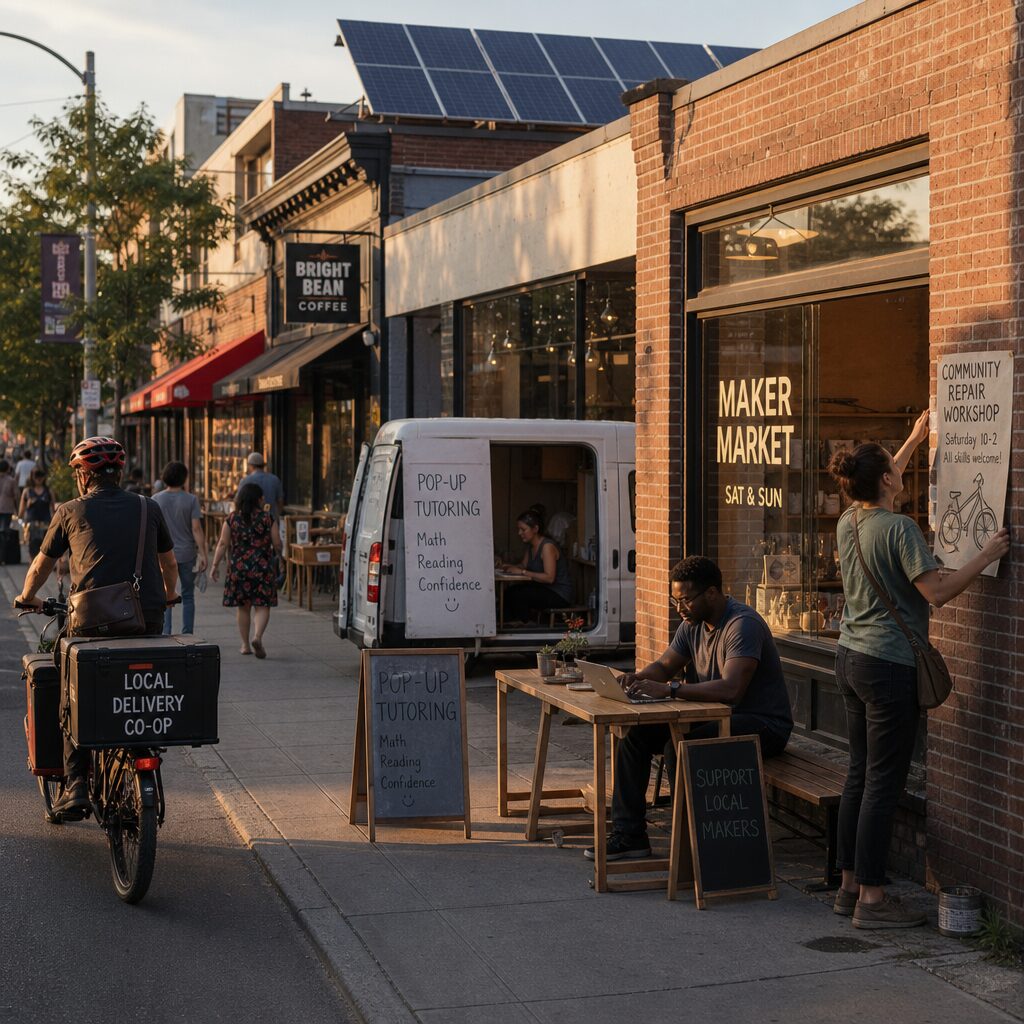
An Unexpected Civic Infrastructure
Most commentary on side hustles treats them as income supplements or lifestyle choices. The less obvious truth is that by 2026 they have begun to function as a form of civic infrastructure. When public services fray under fiscal pressure and global supply chains wobble, a patchwork of local micro-entrepreneurs — tutors, courier cyclists, community tech fixers, urban growers — provide immediate, adaptive capacity. These activities keep neighbourhoods functioning: they deliver goods faster than strained postal systems, teach digital skills when schools are overburdened, and repair small appliances when warranty chains are distant.
Seen this way, a side hustle is not merely a personal project; it is a resilience node. Policymakers and planners who ignore the aggregate effect of these micro-enterprises miss an emergent, decentralised public good. Investing in training, simple licences and microgrants for side hustlers strengthens local economies and reduces societal risk.
The Quiet Rewiring of Labour Markets
By 2026, AI and automation have accelerated role redefinitions across sectors. But rather than eliminating work entirely, these technologies are bifurcating careers: core employment becomes increasingly specialised while routine and platform-enabled gigs proliferate. Side hustles act as the soft interface between skill displacement and new opportunity — a place where people re-skill, experiment and prove market demand for hybrid services that algorithmic systems can’t fully automate.
This rewiring changes power dynamics. Workers who treat side hustles as deliberate R&D for their skills command more bargaining power in primary roles and create portable reputations that travel across platforms and geographies. Understanding this function reframes side hustles as strategic labour-market investments rather than stopgap earnings.
Data, Ownership and the New Value Streams
In a data-driven economy, side hustles are quietly becoming sources of proprietary, human-centred data that big tech does not capture well. A gardener offering climate-adapted plant advice, a local courier mapping micro-traffic patterns, or a part-time tutor compiling bespoke lesson analytics — these are datasets born of situated knowledge.
Entrepreneurs who treat their side hustles as data engines can monetise insights, form cooperatives for collective bargaining with platforms, or licence niche datasets to researchers and local governments. This shift reframes extra income as a pathway to owning and monetising unique information assets, not just selling time.
Social Capital, Mental Health and Identity
Beyond money, side hustles matter because they rebuild social capital eroded by gig isolation and remote work. Shared projects — a weekend craft market, a group-led coding bootcamp, a community solar-install team — create meaningful interactions and roles in which people are valued for skills beyond their corporate job title.
That social dimension has measurable mental-health effects. Purposeful, autonomous side work reduces burnout, anchors identity during career transitions, and provides a rehearsal space for leadership and entrepreneurship. Framing side hustles as psychological as well as financial stabilisers explains why they have outsize importance in contemporary life.
Policy Levers and Practical Steps
If side hustles are infrastructural, what should governments and communities do differently? Small, targeted interventions yield high leverage: simplify micro-business registration, create low-cost liability insurance pools for platform workers, provide accessible microgrants for equipment, and invest in digital identity schemes that let side hustlers port reputation between platforms. Cities can integrate side-hustle marketplaces into local procurement and training programmes, while universities can recognise micro-enterprise experience as creditable learning.
For individuals: treat your side hustle as a modular experiment. Track time, customers and learning outcomes. Capture the data you generate, formalise simple contracts and consider joining or forming local co-ops to share costs and bargaining power. The strategic view — nurturing your side hustle as civic, labour-market and data capital — is what makes it matter more than most people realise.
![Como viver com menos do que você ganha [sem se sentir miserável]](https://productivepathblog.com/wp-content/uploads/2026/05/How-to-Live-Frugally-PTqOcG-559x1024.jpg)
