
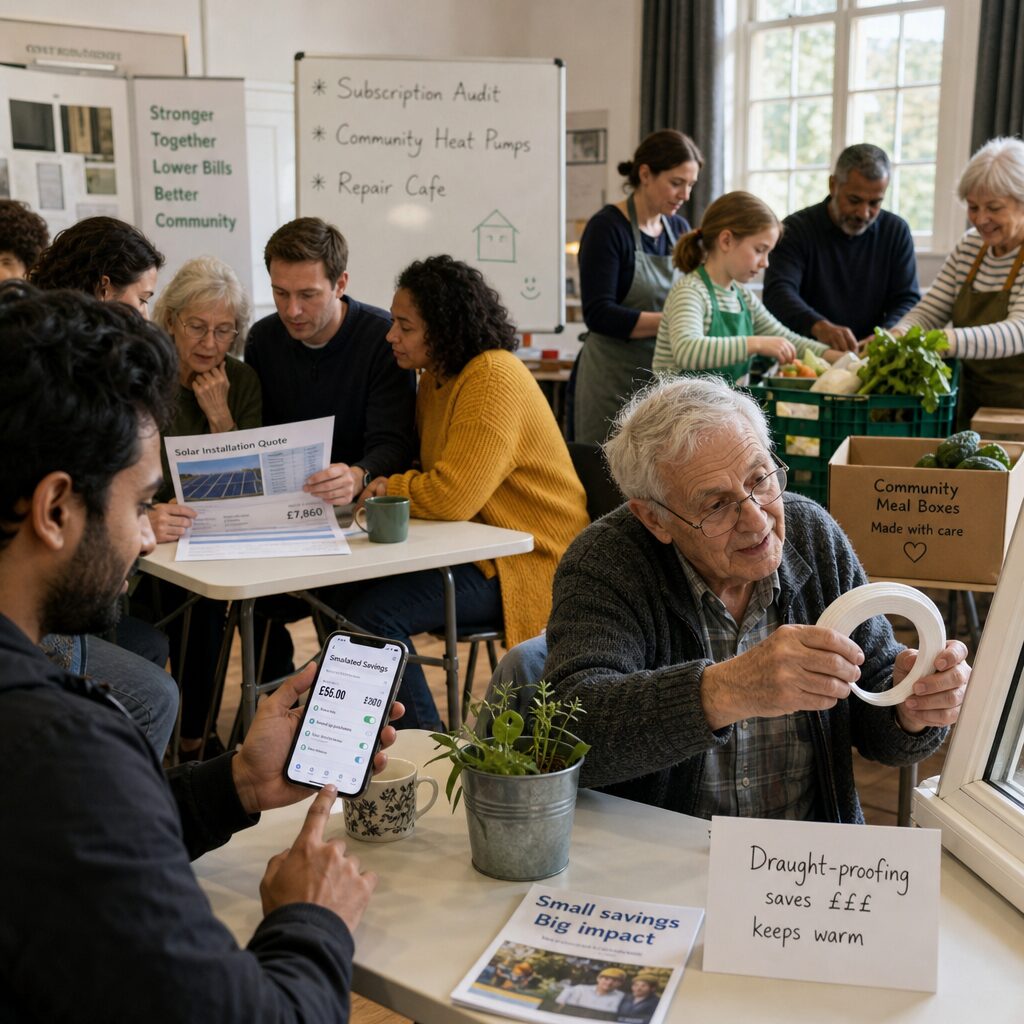
Introduction: Frugal Habits as Practical Problem-Solving Tools
When people think of “10 smart ways to save money every month”, they imagine budgets, coupons and austerity. What’s less obvious is how those methods, when reframed, become tactical solutions to societal and personal problems — from climate resilience to mental health, to small-business survival. This article reframes ten commonplace saving strategies as levers that address real-world challenges. Each section examines one or more saving techniques in action, illustrating outcomes beyond the household ledger.
Rather than a list of tips, consider this a field manual showing how everyday thrift is being repurposed: neighbourhood energy projects using bulk-buying to decarbonise, social enterprises harnessing meal-planning to reduce food waste, or community banks adopting automatic transfers to stabilise incomes. The framing shifts saving from an individual virtue to a collective instrument for change.
Collective Buying and the Energy Transition
Bulk purchases, price comparison and subscription consolidation — classic saving tactics — are now central to community-scale energy projects. Local co-ops pool demand to buy heat pumps, solar panels and batteries at wholesale prices. By applying the same mindset used to negotiate cheaper broadband or supermarket discounts, neighbourhood groups lower upfront costs and accelerate deployment of low-carbon technologies.
This translates to measurable real-world benefits: reduced household energy bills, lower peak grid demand, and faster progress towards local net-zero targets. Municipalities in the UK and across Europe have adopted similar models, using group procurement to secure better finance terms and warranty packages. In short, the logic of saving money becomes the engine for more equitable and rapid decarbonisation.
Meal Prepping, Food Waste Reduction and Food Security
Meal planning and batch cooking are often touted as ways to cut grocery bills. In the real world, these habits are being scaled to tackle food waste and local food insecurity. Food hubs and charities teach households how to plan menus around seasonal, surplus produce; social enterprises organise community cook-ups that turn bulk-bought, rescued food into nutritious meals sold or donated at low cost.
The ripple effects are substantial. Reducing waste lowers disposal costs and emissions, community kitchens create jobs and social bonds, and predictable demand streams help farmers and suppliers plan production, stabilising prices. Thus, a simple monthly habit — plan once, save daily — becomes a stabiliser for local supply chains and a mitigator of hunger.
Automated Saving and Income Stability for Gig Workers
Automatic transfers to savings accounts are a commonplace recommendation. For precarious workers — freelancers, gig economy couriers, seasonal staff — automating small transfers becomes a mechanism for smoothing erratic income and covering shocks like a delayed invoice or vehicle repair.
Platforms and fintechs are applying this principle to design products that round up payments, split income into spend/save/tax pots, and trigger micro-savings when earnings exceed thresholds. These features reduce late-fee reliance, lower the need for high-cost credit, and increase financial resilience. In effect, a behavioural nudge to save monthly can prevent a cascade of socioeconomic harms associated with income volatility.
Smart Shopping, Supply Chain Resilience and Local Economies
Switching to generic brands or shopping at discount stores is usually framed as a way to stretch the household budget. Recast, these behaviours support supply-chain resilience and local economic ecosystems. Community buy-local campaigns encourage residents to compare prices and choose independent suppliers offering better value; that keeps money circulating internally and reduces reliance on fragile global logistics.
During supply disruptions — such as pandemic lockdowns or shipping delays — communities that had diversified their shopping patterns fared better. Encouraging informed, value-driven purchasing is thus not just penny-pinching; it’s a civic strategy to preserve jobs, maintain critical services and reduce system-wide vulnerability.
Reducing Subscriptions: Mental Bandwidth and Time Poverty
Cutting unused subscriptions is often presented as easy money. But the deeper, less-obvious gain is cognitive and temporal. Subscription overload creates decision fatigue and time poverty as people manage renewals, trials and overlapping services. Simplifying digital subscriptions reduces administrative time, lowers stress and leaves more bandwidth for income-generating activities or caregiving.
Organisations that run ‘subscription audits’ with employees report improved focus and morale. On a societal level, fewer unnecessary subscriptions reduce server loads, energy use and electronic waste associated with streaming and cloud services. The small act of cancelling a forgotten subscription thus multiplies into productivity gains and modest environmental wins.
Transport Economies: Car-Pooling, Micromobility and Urban Liveability
Saving by reducing car use — car-pooling, consolidation of trips and switching to micromobility — does more than shrink petrol bills. These practices cut congestion, improve air quality and reclaim urban space. Employers that incentivise pooled commuting reduce parking demand and improve punctuality; councils that support bike-share programmes see lower healthcare costs because of increased physical activity.
When the decision to save on transport is amplified across a neighbourhood, it becomes urban policy: fewer cars, safer streets, and more resilient local transport networks in the face of fuel price shocks or public transport strikes.
Home Efficiency Upgrades as Public Health Interventions
Simple monthly savings — like switching to LED bulbs or draught-proofing doors — are often dismissed as marginal. Aggregated across thousands of households, these upgrades lower energy consumption at peak times and reduce cold-home incidences. Public health initiatives increasingly recognise housing efficiency as a determinant of health; grants for insulation and targeted retrofits reduce hospital admissions for respiratory and cardiovascular conditions.
Framing small retrofitting investments as both bill-saving and health-promoting helps unlock funding from health and social care budgets, turning household-level thrift into public-sector cost avoidance.
Negotiation, Bills Review and Financial Inclusion
Negotiating bills, switching providers and contesting erroneous charges are direct ways to save each month. Community legal clinics and financial advice centres teach negotiation skills to vulnerable citizens, preventing exploitation by high-cost lenders and unclear contracts. Collective negotiation — tenant groups jointly contesting unfair utility surcharges, for instance — has won refunds and policy changes.
These practices extend financial inclusion: when individuals learn to challenge billing practices and access better tariffs, the outcomes are lower household stress, reduced reliance on emergency credit, and improved credit profiles that unlock longer-term assets such as mortgages.
DIY, Repair and Circular Economies
Repair cafes, tool libraries and skill-swapping are modern manifestations of the save-and-share ethos. Rather than discarding broken goods, communities repair and repurpose them, cutting replacement costs and reducing waste. The saving behaviour — “fix rather than replace” — evolves into a circular economic model that creates local jobs, preserves material value and decreases landfill pressure.
Municipal investment in repair infrastructure yields multipliers: lower waste-management costs, training opportunities for youth and reduced raw-material extraction. The moral is that a household habit (mend it) scales into environmental and economic resilience.
Conclusion: From Personal Savings to Systemic Solutions
What begins as a desire to shave cash off monthly expenses can, with deliberate scaling, become a tool for solving public problems. Collective procurement accelerates the energy transition, meal planning fights food insecurity, automated savings stabilise precarious incomes, and simple home improvements reduce health burdens. The common thread is recontextualisation: view everyday saving techniques not merely as personal economics but as building blocks for social innovation.
Policymakers, community organisers and entrepreneurs should treat these behaviours as design principles. Incentivise them, provide infrastructure and scale the most promising models. The payoff is twofold: people keep more of their income, and communities become more resilient, equitable and resource-efficient.
![Como viver com menos do que você ganha [sem se sentir miserável]](https://productivepathblog.com/wp-content/uploads/2026/05/How-to-Live-Frugally-PTqOcG-559x1024.jpg)
