

Most entrepreneurs aren’t actually building a business; they’re just working a second job they can’t quit. If you’re constantly searching for how to scale a side hustle while drowning in manual tasks, you’ve likely hit a ceiling. It’s that exhausting point where growth is limited by your own physical hours. You’re not alone in feeling like you’re playing business rather than leading one. The transition from a time-consuming hobby to a high-margin enterprise requires a fundamental shift in your operational architecture.
This guide promises to transform your perspective from a manual doer to a systems architect. We’ll dismantle the myth that scaling requires more sacrifice. Instead, you’ll learn how to implement strategic organizational frameworks that drive growth through automation. We’re providing a clear roadmap to higher profit margins and a sustainable schedule that allows your business to thrive in 2026. It’s time to stop trading your sanity for incremental gains and start building a machine that scales.
Key Takeaways
- Identify your “Time Ceiling” and use a high-value task audit to distinguish between low-level busy work and the strategic levers that drive revenue.
- Master the Multi-Hyphenate Framework to manage your energy rather than just your time, ensuring growth remains sustainable alongside a 9-5.
- Discover how to scale a side hustle through 90-day strategic sprints that prioritize profit-heavy metrics over vanity numbers.
- Implement “mental outsourcing” by using professional templates to automate complex decision-making and streamline your daily operations in minutes.
The Scaling Paradox: Why Side Hustles Stall at the Time Ceiling
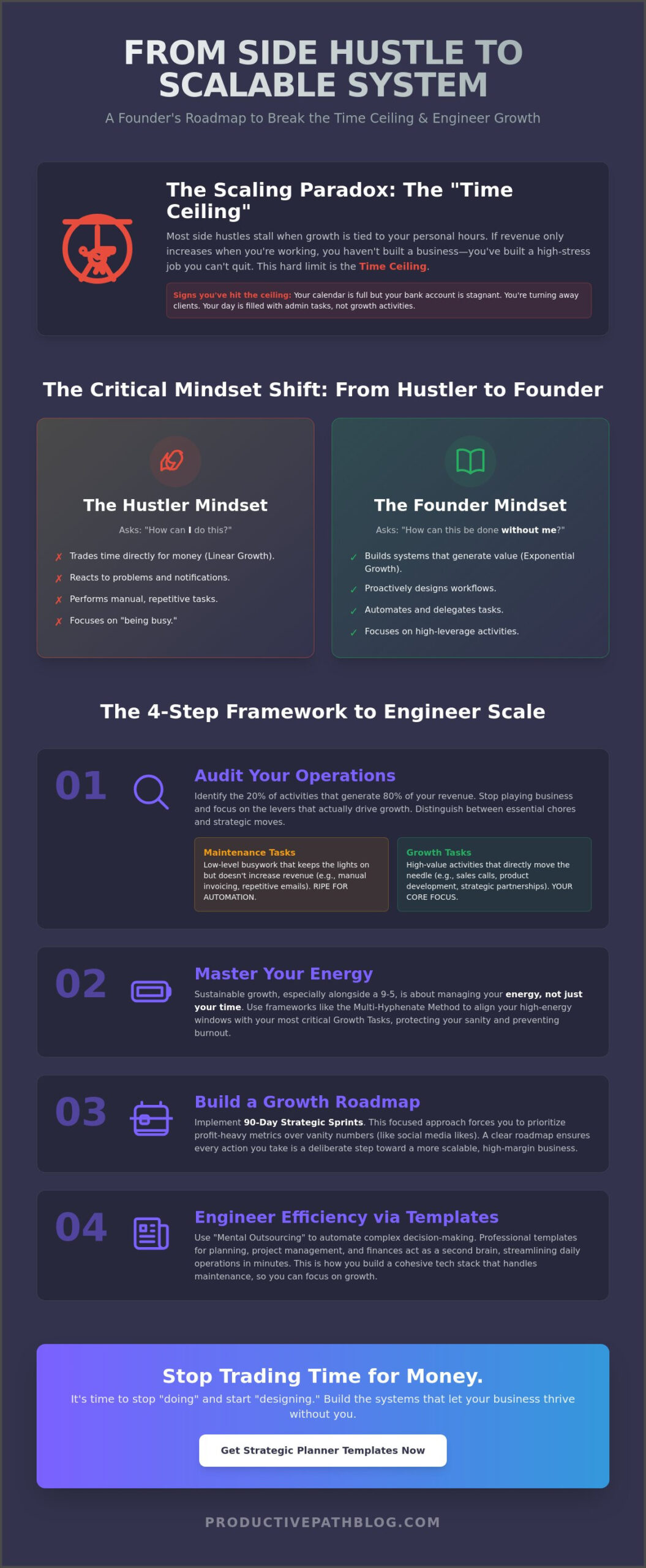
Growth is often mistaken for success; however, in the world of solopreneurship, growth without systems is just a slow march toward burnout. While most people understand what a side hustle is in a general sense, few understand the mechanics of turning that extra income stream into a scalable asset. Growing means your expenses and time commitment increase alongside your revenue. Scaling is different. It’s the art of increasing output while keeping input relatively flat. If your revenue only moves when you’re physically working, you haven’t built a business; you’ve built a cage. This is the Time Ceiling. It’s the hard limit where your manual effort can no longer generate more money because you’ve run out of hours in the day.
To break through this ceiling, you must undergo a psychological shift. You’re moving from a hustler who grinds to a founder who engineers. A hustler asks, “How can I do this?” A founder asks, “How can this be done without me?” You’ll know you’re ready to learn how to scale a side hustle when you see these three signs: your calendar is full but your bank account is stagnant; you’re turning away high-paying clients due to lack of bandwidth; and your days are consumed by administrative friction rather than creative output. These aren’t failures. They’re indicators that your current framework has reached its maximum capacity.
Hustling vs. Engineering Growth
Working harder is a failing strategy. It’s a linear solution to an exponential problem. Scaling requires intellectual curiosity to uncover exactly where your current methods are leaking energy. Instead of reacting to every notification, you must pivot toward proactive strategic planning. This involves identifying the operational bottlenecks that prevent you from stepping away. You’re no longer just the worker; you’re the architect of the workflow. When you stop “doing” and start “designing,” you find the leverage points that allow for how to scale a side hustle without sacrificing your sanity.
The 2026 Economic Landscape for Solopreneurs
The 2026 market doesn’t reward generalists; it rewards niche authority and systemized delivery. As the gig economy becomes more saturated, professional-grade organization is the only way to stand out from the crowd. Side Hustle Scaling is the transition from labor-intensive to systems-intensive operations. In this landscape, your ability to document and automate your value is your greatest competitive advantage. Customers in 2026 expect seamless, high-speed interactions that only a systems-driven business can provide. Stagnant habits are like heavy weights; you must drop them to move faster.
Auditing Your Operations: Identifying the Levers of Growth
Scaling isn’t about doing more; it’s about doing what matters. To master how to scale a side hustle, you must first treat your operations like a laboratory. Most entrepreneurs are blind to the friction points that quietly bleed their productivity dry. These are the repetitive emails, the manual invoice tracking, and the disorganized project files that act as sand in the gears of your growth. By applying the 80/20 rule, you’ll likely discover that 80% of your revenue flows from just 20% of your activities. The rest is just noise. Identifying these high-ROI levers allows you to stop playing business and start engineering a machine that generates value while you sleep.
Your tech stack in 2026 should be a cohesive ecosystem, not a junk drawer of disconnected apps. If you’re still using manual workarounds for tasks that could be automated, you’re intentionally limiting your ceiling. A strategic audit involves evaluating every tool in your arsenal for its ability to handle a 10x increase in volume. If a tool requires manual intervention at every step, it’s a liability. True efficiency is found when your organizational tools serve as a second brain, handling the “maintenance” so your primary brain can focus on “growth.”
The Operational Audit Framework
Start by deploying a daily tracker for exactly one week. Don’t change your habits; just observe them with intellectual curiosity. Categorize every minute into Maintenance Tasks, the essential but non-revenue-generating chores, and Growth Tasks, the strategic moves that actually move the needle. Maintenance keeps the lights on; growth builds the empire. If you find yourself trapped in the former, you’ve identified a process ripe for template-based automation. Utilizing professional planner templates can instantly bridge the gap between chaotic manual work and systemized efficiency.
From Chaos to Clarity: The Founder’s Audit
A scalable business requires a centralized Command Center. This is a single source of truth for all your business data, from lead tracking to financial projections. In the 2026 landscape, manual data entry is a relic. It’s an invitation for human error and a massive drain on your cognitive energy. A true founder uses strategic foresight to predict where their current systems will break as volume increases. If your current workflow feels like a collection of mismatched tools, it’s time to audit for cohesion. Understanding how to scale a side hustle means recognizing that professional-grade organization isn’t a luxury; it’s the foundation of your future scale.
Strategic Time Management: The Multi-Hyphenate Framework
Forget the generic advice about simply waking up earlier. If you want to know how to scale a side hustle without burning out by mid-year, you must stop managing your time and start managing your cognitive load. In 2026, the traditional 9-5/5-9 split is no longer a battle of hours; it’s a battle of focus. Time Blocking 2.0 treats your schedule as a high-stakes portfolio where every hour is an investment. By shifting from a reactive “to-do list” mindset to a proactive “energy management” framework, you ensure that your most complex strategic decisions happen when your brain is at its peak. This isn’t just about finding time. It’s about engineering the right environment for growth to occur naturally.
The batching revolution is your most powerful weapon in this fight. Context switching is a silent profit killer that resets your mental momentum every time you jump from an email to a creative task. Instead, try producing a full week of social media content or administrative work in a single three-hour window. This concentration of effort creates a flow state that manual, piecemeal work can never replicate. Integrating professional planner templates for side hustle management allows you to visualize this weekly load, transforming abstract goals into a concrete, manageable map of your operations.
The Architecture of a Productive Week
Designing a weekly rhythm requires protecting your deep work sessions with a sense of urgency. Use “Themed Days” to group similar cognitive tasks together; for example, designate Tuesdays for client delivery and Thursdays for growth-oriented marketing. This structure minimizes the mental friction of shifting between different business functions. You must also include “Recovery Blocks” in your schedule. Scaling is a marathon, not a sprint. Without dedicated periods for rest, your strategic foresight will dim, leading to the very burnout that stalls most part-time ventures.
Leveraging Digital and Printable Tools
While digital apps are excellent for notifications, the act of physical writing in a planner enhances strategic retention and sharpens your focus. Many successful founders find a hybrid approach works best, using digital tools for automation and printable inserts for high-level weekly mapping. Whether you prefer a sleek digital interface or the tactile nature of paper, the goal is clarity. A weekly planner template acts as a contract with your future self, ensuring that your long-term vision isn’t sacrificed for short-term distractions. This disciplined approach is a fundamental requirement for anyone serious about how to scale a side hustle into a lasting enterprise.
Building Your Growth Roadmap: The 90-Day Strategic Sprint
Annual goals are often too abstract for the side hustler. When you’re balancing a 9-5 with an emerging venture, a twelve-month horizon feels like a lifetime away. This leads to procrastination and a lack of urgency. The 90-day strategic sprint is the optimal window for experimentation; it’s long enough to gather meaningful data but short enough to maintain an intense focus on execution. During this period, your primary objective is to shift your “North Star” metrics. Forget about vanity numbers like social media followers or website hits. If you want to master how to scale a side hustle, you must focus on profit margins, customer acquisition costs, and your hourly effective rate. These are the only figures that tell the true story of your business’s health.
A successful sprint requires breaking these high-level objectives into manageable, weekly milestones. This prevents the “playing business” trap where you spend hours on low-impact tasks. By using template-driven sprints, you create a repeatable rhythm that keeps you moving forward even when your energy is low. About halfway through, you must perform a “Mid-Sprint Audit.” This is a calculated pause to adjust your strategy based on real-world feedback. Are your automation tools actually saving time? Is your new revenue lever converting? Don’t be afraid to pivot if the data suggests your current path is a dead end.
Phase 1: The Foundation (Days 1-30)
The first month is about standardization. You cannot scale chaos. Your goal is to transform your most frequent tasks into repeatable Standard Operating Procedures (SOPs). This creates a “manual” for your business that reduces cognitive load. Simultaneously, you must audit your digital workspace; cluttered folders and a messy inbox are friction points that slow down your response times. Utilizing a quarterly planner template allows you to map out these first 30-day milestones with surgical precision, ensuring that the foundation is strong enough to support future growth.
Phase 2: The Expansion (Days 31-90)
Once the foundation is set, you move into testing new revenue levers. This might involve productizing a service or automating your lead generation process. The key here is “Minimum Viable Scale.” Test your growth theories with the smallest possible investment of time and capital before committing fully. Throughout this phase, monitor the impact of your new systems on your hourly effective rate. If your revenue is increasing while your working hours remain stable, you’ve successfully cracked the code of how to scale a side hustle. To accelerate this transition, you can download our professional business growth templates and start your first 90-day sprint with total clarity.
Engineering Efficiency: How Strategic Templates Fuel Your Scale
Decision fatigue is the silent killer of the ambitious. Every minute you spend wondering what to do next is a minute stolen from your high-level strategy. This is where strategic templates act as a form of “mental outsourcing.” By using pre-designed frameworks, you’re essentially offloading the cognitive heavy lifting of organizational design to a proven system. This allows you to save your precious mental bandwidth for the complex, creative decisions that actually drive revenue. When you understand how to scale a side hustle, you realize that your job isn’t to reinvent the wheel every morning; it’s to keep the wheel turning at a higher velocity.
The “Instant Download” advantage is a critical competitive edge in the 2026 digital economy. You don’t have weeks to spend tinkering with custom spreadsheets or complex database builds. Implementing professional systems in minutes allows you to pivot quickly and capitalize on market shifts. These digital planner templates bridge the vital gap between your visionary goals and daily execution. Whether you’re managing inventory for an e-commerce store, tracking client pipelines in a consulting firm, or batching content for a niche media brand, specialized layouts ensure your niche-specific needs are met without manual friction.
Why Professional Planners Outperform Generic Apps
Generic productivity apps are often notification factories designed to keep you clicking rather than working. In contrast, dedicated planner templates provide a distraction-free environment that encourages deep work. Their structured layouts force a hierarchy of importance, moving you away from a “first-in, first-out” task mindset and toward strategic prioritization. While digital tools offer portability, many founders find that “Printable Daily Planners” offer a tactile advantage for tactical execution. The physical act of checking off a high-ROI task creates a neurological feedback loop that sustains your scaling momentum.
Your Next Step: From Hustle to Enterprise
The transition from a part-time venture to a sustainable enterprise is rarely an accident of effort. It’s a result of intentional engineering. Your next immediate step is to audit your current organizational tools with total honesty. Are they physical objects that have lost their utility, or are they modern engines of growth? Adopting a systems-first approach for 2026 means rejecting the status quo of “just getting by” and embracing the discipline of professional organization. This is the foundation of how to scale a side hustle into something that provides both financial freedom and operational peace. Browse our professional planner templates to start scaling your side hustle today.
Master the Architecture of Your Future Business
The journey from a frantic side hustle to a systemized enterprise isn’t paved with more hours. It’s paved with better engineering. By identifying your time ceiling and auditing your operations for high-ROI tasks, you’ve already taken the first step toward true growth. You now have the framework to manage energy rather than just time; ensuring your 90-day sprints are fueled by data rather than guesswork. Learning how to scale a side hustle in 2026 requires a rejection of the manual status quo in favor of professional-grade organization. It’s about moving from the person who does the work to the founder who designs the workflow.
Strategic foresight means preparing for the volume you want, not just the volume you have. Our systems are used by 10,000+ organized professionals who value precision over busywork. With instant downloads and strategic layouts designed for high-performance entrepreneurs, you can implement these frameworks immediately. Scale your output with our professional planner templates and reclaim your schedule today. You’ve built the vision. Now, it’s time to build the machine that makes it sustainable. Success is within your reach if you’re willing to systemize it.
Frequently Asked Questions
What is the difference between growing and scaling a side hustle?
Growing is a linear expansion where your revenue increases only as you add more resources or hours. Scaling is an architectural shift where your systems handle increased volume without a proportional increase in your manual labor. If you’re focused on how to scale a side hustle, your goal is to decouple your income from your time. Growth often leads to burnout; scaling provides the infrastructure for freedom.
When should I consider quitting my day job to scale my side hustle?
You should consider making the transition once your side hustle revenue consistently covers your essential expenses and you’ve secured a financial runway of six to twelve months. Operational maturity is just as important as financial stability. If your business systems can handle full-time volume without your constant physical intervention, you’ve successfully moved from a part-time founder to a CEO ready for expansion.
How much time should I realistically spend on scaling tasks each week?
Dedicating approximately 20% of your weekly hustle hours to “on-the-business” tasks is a strategic necessity. If you work 15 hours a week, spend at least three hours on system audits, automation setup, or template implementation. This disciplined allocation ensures you aren’t just reacting to daily fires. It forces you to build the ladders required to climb out of manual, repetitive labor.
Can I scale a side hustle without hiring employees?
Yes; scaling in 2026 is frequently achieved through high-leverage automation rather than increasing your headcount. By utilizing sophisticated templates and AI-driven workflows, a single founder can manage the output that previously required a small team. This “lean scaling” approach is highly effective for maintaining high profit margins while keeping your organizational complexity at a manageable level for a solo operator.
What are the best digital tools for side hustle organization in 2026?
The 2026 landscape favors integrated ecosystems such as AI-powered content tools, automated CRMs, and centralized organizational planners. Tools that offer “instant download” capabilities or template-based structures are particularly valuable for rapid implementation. These systems act as a second brain. They allow you to maintain niche authority and professional standards without getting bogged down in the administrative minutiae that stalls growth.
How do I avoid burnout while trying to grow my business part-time?
Avoid burnout by shifting your focus from time management to energy management. Implement “Recovery Blocks” and “Themed Days” to prevent the mental friction caused by constant context switching. When you treat your cognitive energy as a finite strategic resource, you can maintain the long-term momentum required to transform a hobby into a sustainable enterprise without sacrificing your personal well-being.
Is it better to use a digital or printable planner for business scaling?
The choice depends on your specific workflow; digital planners offer seamless automation while printable versions enhance strategic retention and focus. Many high-performance entrepreneurs use a hybrid model. They utilize digital tools for notifications and data tracking, but they rely on the tactile nature of printable planners for deep-work sessions and the high-level mapping of their how to scale a side hustle strategy.
How do I track my progress during a 90-day growth sprint?
Focus on “North Star” metrics such as profit margins and customer acquisition costs rather than vanity numbers like social media likes. Use a dedicated quarterly tracker to perform a “Mid-Sprint Audit” at the 45-day mark. This allows you to adjust your tactics based on real-world data. It ensures your 90-day roadmap stays aligned with the mechanics of sustainable growth rather than just temporary activity.
![Como viver com menos do que você ganha [sem se sentir miserável]](https://productivepathblog.com/wp-content/uploads/2026/05/How-to-Live-Frugally-PTqOcG-559x1024.jpg)
