

The difference between a hobby that drains your energy and a business that builds your wealth isn’t the volume of hours you put in. It’s the secondary operating system you build to manage them. Learning how to organize your side hustle is the only way to escape the constant decision fatigue that comes from switching between employee and boss mindsets. You’re likely juggling a full-time career while trying to track the 2026 standard mileage rate of 72.5 cents and prepping for the June 15th tax deadline, all while feeling like you’re one missed spreadsheet away from total chaos.
It’s a common struggle for the nearly 17 million Americans currently working for themselves. You want to grow, but the mental load of manual tracking is holding you back. This guide will help you transform that chaos into a streamlined business with a comprehensive organizational roadmap. We’ll explore how to centralize your documentation, reduce your mental load through strategic templates, and build a daily routine that actually drives you toward your long-term goals.
Key Takeaways
- Adopt a founder’s “Dual-Operating System” to stop your corporate habits from sabotaging your entrepreneurial growth.
- Move beyond the simple to-do list by implementing Task Architecture and flexible time-blocking tailored for the modern economy.
- Learn how to organize your side hustle through a rigid administrative hierarchy that puts legal and financial security first.
- Audit your planning environment to find the perfect balance between high-speed digital alerts and the deep focus of analog templates.
- Prepare for future scaling by developing Standard Operating Procedures that allow you to transition from daily tasks to strategic management.
The Dual-Operating System: Shifting from Employee to Founder
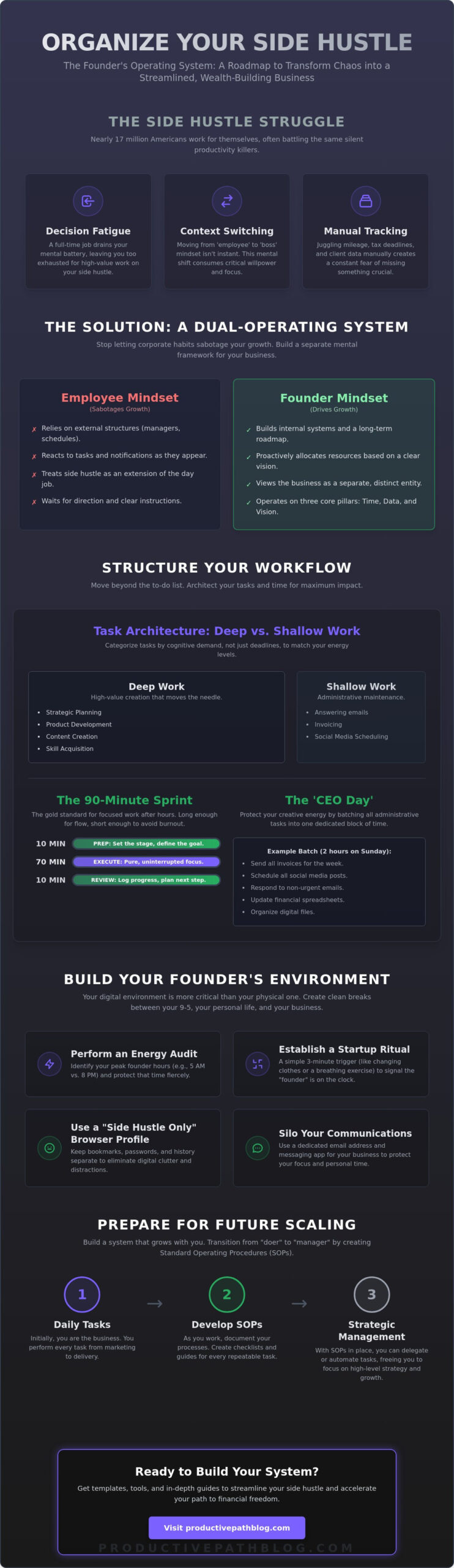
Success in the gig economy requires more than just a good idea; it demands a psychological overhaul. Most people treat their secondary income as an extension of their corporate life, but this is a strategic error. To understand what is a side hustle in 2026, you must view it as a separate entity requiring its own cognitive framework. This is the Dual-Operating System. It’s a mental infrastructure that allows multi-hyphenate professionals to toggle between being a directed employee and a visionary founder without losing momentum.
Traditional 9-5 habits often sabotage growth because they rely on external structures like managers or fixed schedules. When you’re the boss, those structures vanish. If you don’t replace them, you’ll find yourself drifting. A robust side hustle OS rests on three pillars: Time (the allocation of deep work), Data (the metrics of your progress), and Vision (the long-term roadmap). Mastering how to organize your side hustle starts with acknowledging the massive context-switching cost. Moving from a high-stakes meeting at your day job to a creative task for your business isn’t instant. It drains your willpower battery, often leaving you too exhausted to do anything but scroll through social media by 7 PM.
Auditing Your Current Mental Bandwidth
Decision fatigue is the silent killer of evening productivity. If your primary job requires hundreds of small choices, your brain will be fried before you even open your laptop at home. Perform a weekly energy audit to identify your peak founder hours. For some, this is 5 AM before the world wakes up; for others, it’s a focused two-hour block on Tuesday nights. Once you find your window, establish a startup ritual. This could be as simple as changing your clothes or a specific three-minute breathing exercise. It signals to your brain that the employee is off the clock and the founder has arrived.
Setting Boundaries: The Physical and Digital Workspace
While a beautiful home office is nice, your digital environment is far more critical for success. You need a clean break between your personal life and your business data. Learning how to organize your side hustle effectively requires creating a side hustle only browser profile. This ensures that your work bookmarks, saved passwords, and history don’t bleed into your leisure time. Separate your communication channels immediately. Use a dedicated email address and a separate messaging app for clients. By silo-ing these digital assets, you protect your focus and ensure that when it’s time to work, your environment is already optimized for execution.
Structuring the Workflow: Task Architecture and Time-Blocking
To-do lists are where good intentions go to die. For the side-hustler, a simple list lacks the context of energy levels and deadline priority. This is why you need Task Architecture. Think of it as the structural blueprint of your business; it categorizes tasks by their cognitive demand rather than just their due date. When you master how to organize your side hustle using this framework, you stop reacting to the loudest notification and start building real equity. You move from being a passive participant in your schedule to an active architect of your growth.
The 2026 approach to time-blocking rejects the rigid, hour-by-hour schedules that corporate environments demand. These fail because life happens. A late meeting at your 9-5 can wreck a rigid plan, leading to a cycle of guilt and abandoned goals. Instead, adopt fluid blocks. Differentiate between Deep Work, the high-value creation that moves the needle, and Shallow Work, the administrative maintenance like answering emails. Visualizing these blocks is essential. Using a planner template for side hustle allows you to see the gaps in your week where momentum can be built without over-committing your limited energy.
The 90-Minute Sprint Methodology
Most people think they need four-hour blocks to be productive. They don’t. In the high-pressure environment of after-work hours, 90 minutes is the gold standard for human focus. It’s long enough to achieve flow but short enough to avoid burnout. Break it down: 10 minutes of prep to set the stage, 70 minutes of pure execution, and 10 minutes for a review and shutdown ritual. This prevents the after-work slump from turning into a lost evening. By pre-planning these sprints, you remove the friction of deciding what to do when you’re already tired.
Batching Admin Tasks to Protect Creative Flow
Admin is a parasite that eats your creative energy if left unchecked. The solution is a “CEO Day.” Even if it’s just two hours on a Sunday afternoon, use this time to batch your invoicing, social media scheduling, and email management. This protects your weeknights for high-impact work. For those days when the 9-5 is particularly brutal, keep a “low-energy list.” These are small, mindless tasks like cleaning up your digital files or updating your 2026 tax log. It ensures you make progress even when your brain is at 10% capacity.
Administrative Infrastructure: Organizing Finances and Legal
The back office is the engine room of your enterprise. While the creative work feels like the “real” business, your administrative infrastructure is what prevents it from collapsing under its own weight. Establishing a rigorous paper trail from day one is non-negotiable. Digital storage isn’t just a convenience; it’s a shield against regulatory scrutiny and a prerequisite for scaling. To master how to organize your side hustle, you must respect the hierarchy of business admin: Legal first, followed by Finance, and finally Operations. If the legal foundation is cracked, your operational speed won’t matter.
Integrating these administrative checks into your daily schedule template is the simplest way to maintain order. Instead of a monthly “tax panic,” spend five minutes at the end of each session logging miles at the 2026 rate of 72.5 cents per mile or filing a digital invoice. This turns a monumental burden into a series of micro-tasks. By the time the Q2 estimated tax deadline of June 15, 2026, rolls around, your documentation will be a source of confidence rather than stress.
Digital Receipt and Expense Management
The “Zero-Box” method is your best defense against administrative bloat. Treat your business inbox and receipt folder like a physical desk: if it’s there at the end of the day, it’s a lingering debt. Choose an automated software solution that scales with your revenue, ensuring it can handle the 2026 1099-NEC reporting threshold of $2,000. Itemized receipts are the gold standard for tax documentation. This level of precision allows you to claim the Qualified Business Income (QBI) deduction of up to 20% with total certainty.
Separating Personal and Business Assets
Commingling funds is a strategic trap that clouds your financial reality. Opening a dedicated business bank account provides a profound psychological benefit; it validates your hustle as a legitimate venture. Automate your tax strategy by transferring the 15.3% self-employment tax rate from every payment into a separate account immediately. As your income grows, move from hobbyist status to a formal legal entity like an LLC. This transition protects your personal assets and signals that you’ve evolved from “doing” a job to “owning” a business.
Choosing Your Planning Environment: Digital vs. Analog
Does your planning tool sharpen your focus or scatter it? The environment you choose for your business strategy is just as critical as the strategy itself. Generic productivity apps often fail because they’re built for the masses, not the specific constraints of someone balancing a 9-5 with a growth venture. When you’re refining how to organize your side hustle, you must decide where your deep thinking happens versus where your tracking lives. A misaligned system creates cognitive friction: that subtle resistance you feel when it’s time to work but you can’t find your notes.
In 2026, the most effective professionals are moving toward a Hybrid System. This approach uses digital tools for what they do best – alerts, recurring reminders, and searchability – while reserving analog methods for high-level strategy. This is where planner templates for productivity become indispensable. They offer a structured yet flexible framework that bridges the gap between high-level vision and daily execution. They’re not just pages; they’re the architectural plans for your business’s future.
The Power of Digital Planner Templates
Speed is a competitive advantage. Digital planner templates provide instant-access downloads that allow you to pivot your strategy the moment you identify a market shift. Using these templates on a tablet offers a unique synthesis: the tactile feel of handwriting with the power of digital search. You can sync your entire business roadmap to cloud storage, ensuring that whether you’re on a lunch break or a commute, your data is accessible. It’s about creating a portable command center that scales at the speed of your revenue.
Printable Planner Pages for Deep Strategy
Screen fatigue is a legitimate threat to your evening productivity. After eight hours at a corporate workstation, the last thing your brain needs is another glowing rectangle. Printable “Project Roadmaps” allow you to step away from the digital noise and visualize long-term side hustle growth in a physical space. Many founders are now creating a “Founder Binder” – a physical archive for offline brainstorming sessions. This tactile environment encourages slower, more rigorous thinking that digital interfaces often discourage. If you’re ready to stop reacting and start building, explore our full collection of professional planner templates to find your perfect fit.
Scaling Your System: From Hustle to Sustainable Venture
Growth is a double-edged sword. While increasing revenue is the ultimate goal, it often exposes the cracks in an unrefined organizational structure. If your current workflow relies entirely on your personal memory or a chaotic desktop, you haven’t built a business; you’ve simply created a second, more demanding job. Transitioning from “doing” the work to “managing” the venture requires a fundamental upgrade in your operational logic. It’s the moment you stop fighting daily fires and start building the firewalls that protect your time and energy.
The first sign that your system needs an overhaul is when you feel you’ve hit a ceiling despite having more demand than ever. To break through, you must master how to organize your side hustle for delegation. This involves moving away from monthly survival mode and toward a long-term trajectory. Utilizing a quarterly planner template allows you to pivot your focus toward yearly growth, ensuring that your daily actions align with the big-picture milestones you set during your initial founder audit. You must implement an “Audit and Refine” cycle: a dedicated monthly session where you ruthlessly evaluate which parts of your system are driving results and which are just creating digital clutter.
Building Your Side Hustle SOPs
Standard Operating Procedures (SOPs) are the bridge between a solo hustle and a scalable enterprise. You should document every recurring task, from your social media posting schedule to the intricacies of client onboarding. By creating clear, step-by-step templates, you ensure consistency and quality as you prepare to hire your first virtual assistant or contractor. A well-crafted SOP is a freedom document for the founder; it’s the only way to reclaim your time without sacrificing the integrity of your brand.
The 2026 Vision: Quarterly Goal Alignment
Success in the modern economy is measured by more than just your bank balance. You need to track both “Lagging” indicators, like your total quarterly revenue, and “Leading” indicators, such as the number of new leads generated or hours spent on deep work. A goal setting planner template plays a crucial role here, acting as a compass that maintains your motivation when the 9-5 gets heavy. As you look toward 2026, use these metrics to plan for the “Great Leap.” You’ll know your organization is ready for full-time status when your systems can run independently of your constant manual intervention, proving that you’ve successfully learned how to organize your side hustle into a sustainable, self-managing asset.
Engineering Your Entrepreneurial Future
Success in 2026 demands a departure from the “hustle harder” mentality. It requires a transition to “hustle smarter” through a dedicated secondary operating system. By implementing task architecture and a robust administrative infrastructure, you protect your mental bandwidth from the friction of context-switching. You’ve learned that mastering how to organize your side hustle is the bridge between a draining hobby and a scalable business asset that works for you. It’s about moving from daily survival to quarterly strategic growth.
Don’t let your vision get buried under administrative clutter or decision fatigue. You can start refining your workflow immediately with tools designed for high-impact results. Explore our Strategic Planner Templates to streamline your side hustle today. Our instant-access digital downloads are specifically designed for strategic task prioritization and are trusted by over 10,000 organized entrepreneurs. Your transition from employee to founder starts with the systems you build today. You have the framework; now it’s time to execute.
Frequently Asked Questions
What is the best way to organize a side hustle with a full-time job?
The most effective strategy is to implement a “Dual-Operating System” that creates a clear cognitive boundary between your 9-5 role and your founder responsibilities. This involves using energy-based scheduling to ensure you don’t waste your peak creative hours on low-value administrative tasks. By treating your side business as a separate entity with its own dedicated digital environment, you significantly reduce the mental load of switching between mindsets.
Do I need a separate bank account for my side hustle immediately?
Yes, you should establish a dedicated business bank account as soon as you begin earning income. Maintaining a clear separation between personal and professional assets is critical for legal protection and simplifies your bookkeeping significantly. This financial distance also makes it much easier to track when you reach the $400 net income threshold that requires you to file a tax return for your self-employment earnings.
How can I manage my time effectively for a side business?
Effective time management relies on “Task Architecture” rather than simple to-do lists. Group your high-impact work into 90-minute execution sprints to maximize your flow state during limited evening or weekend hours. This methodology prevents the “after-work slump” from derailing your progress. By pre-planning these blocks in a structured template, you remove the friction of deciding what to do when your willpower is naturally lower.
What tools are essential for side hustle organization in 2026?
Your toolkit should include a strategic planner template, cloud-based accounting software, and a dedicated digital filing system. These tools are essential for managing the 2026 1099-NEC reporting threshold of $2,000 and maintaining a reliable paper trail. A hybrid system that uses digital tools for alerts and analog templates for deep strategy often provides the best balance of speed and focus for modern entrepreneurs.
How do I track my side hustle expenses for taxes?
Adopt a “Zero-Box” method where you digitize and file every itemized receipt immediately upon purchase. For vehicle use, you must log every business trip to take advantage of the 2026 standard mileage rate of 72.5 cents per mile. Learning how to organize your side hustle expenses through consistent daily logging will ensure you’re prepared for critical deadlines, such as the Q2 estimated tax payment on June 15, 2026.
Can a digital planner really improve my side hustle productivity?
A digital planner enhances productivity by offering instant searchability and seamless syncing across all your devices. It allows you to carry your entire business roadmap in your pocket, making it easier to utilize small pockets of time throughout the day. When you use a digital framework designed for strategic prioritization, you ensure that every micro-task you complete is actually moving you toward your long-term quarterly goals.
How many hours a week should I spend on side hustle organization?
Most successful side-hustlers find that two hours on a “CEO Day” plus ten minutes of daily maintenance is the optimal rhythm. This small weekly investment prevents administrative debt from accumulating and causing burnout. Consistency is the key; it’s much more effective to spend seventy minutes a week on organization than to attempt a frantic, day-long organizational overhaul once a month when things feel chaotic.
What should I do if I feel overwhelmed by my side hustle admin?
If administration feels like a burden, it’s a sign that your current systems lack the necessary structure to scale. Start by documenting your recurring workflows into Standard Operating Procedures (SOPs) to remove the guesswork from your daily routine. Reframing how to organize your side hustle through the use of professional templates can transform overwhelming chaos into a streamlined process that eventually allows for easier delegation or automation.
![Como viver com menos do que você ganha [sem se sentir miserável]](https://productivepathblog.com/wp-content/uploads/2026/05/How-to-Live-Frugally-PTqOcG-559x1024.jpg)
