

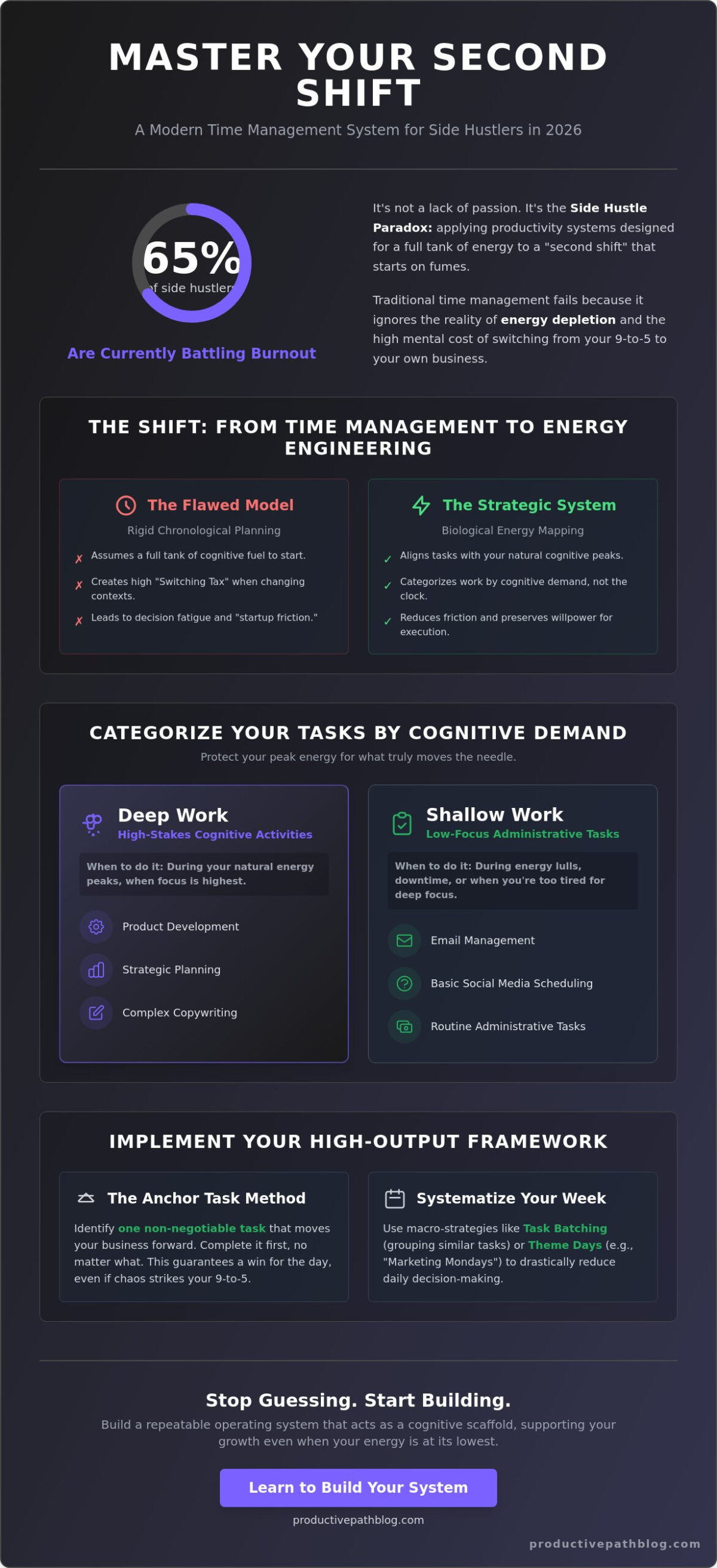
Did you know that 65% of side hustlers are currently battling burnout? It isn’t for lack of passion or a weak work ethic. It’s because most are trying to build a future on the fumes of their nine-to-five. Effective time management for side hustlers in 2026 isn’t about squeezing more minutes out of a dry sponge. It’s about engineering a system that eliminates the friction of starting. You’re likely exhausted from the mental gymnastics of switching from corporate spreadsheets to your own brand strategy. The guilt of neglected personal time often feels heavier than the actual workload. It’s a cycle of slow progress that leads straight to demotivation.
You deserve a strategy that respects your well-being while fueling your ambition. This article will help you master the architectural frameworks and mental systems required to scale your business without sacrificing your primary career. We’ll explore a repeatable weekly system designed to reduce your mental load and ensure measurable growth. By the end, you’ll have a clear, visionary path to transform your “second shift” into a high-output engine that runs on precision rather than sheer exhaustion.
In this article, you will learn how to engineer a high-performance side business without compromising your primary career. We cover the transition from basic productivity to strategic systems designed for the modern multi-hyphenate.
- The Side Hustle Paradox: Understand why traditional 9-to-5 productivity models fail when applied to irregular evening hours.
- Biological Energy Mapping: Learn to categorize tasks by cognitive demand and align them with your natural energy peaks rather than just a clock.
- Strategic Frameworks: Compare task batching and theme days to find the macro-strategy that fits your limited weekend availability.
- Operational Systems: Discover how using a goal setting planner template acts as a cognitive scaffold to bridge the gap between your vision and daily action.
- The Transition Threshold: Master the principles of time management for side hustlers to recognize exactly when your business is ready for full-time growth.
The Side Hustle Paradox: Why Traditional Productivity Fails Multi-Hyphenates
Why do most side hustles stall before they reach escape velocity? It isn’t a lack of ambition. It’s the Side Hustle Paradox: the fundamental friction between the stability of a corporate role and the high-stakes agility of entrepreneurship. Most professionals attempt to apply standard time management techniques designed for a linear workday. These methods assume you’re starting with a full tank of cognitive fuel. For the multi-hyphenate, the “second shift” begins exactly when that fuel is running low.
Traditional productivity fails in the evening because it ignores the reality of energy depletion. You can’t manage your side business using the same rigid structures you use at your desk job. The cost of context switching is simply too high. This is the hidden drain on your momentum. Every time you pivot from a corporate spreadsheet to your own brand strategy, your brain pays a “switching tax” that depletes your remaining focus. Effective time management for side hustlers isn’t about working harder. It’s about engineering a system that removes the need for willpower entirely.
The Mental Cost of the Second Shift
The transition between your primary career and your business is the most dangerous part of your day. This is where decision fatigue takes hold. After eight hours of making choices for an employer, your capacity for high-level strategic thought is compromised. This results in Startup Friction. It’s that heavy, paralyzed feeling when you finally sit down to work but spend forty minutes just deciding which task to tackle first. To scale, you must eliminate these micro-decisions. You need a setup that allows you to slide into deep work without the mental weight of planning on the fly.
Why 2026 Demands a Strategic Organizational Pivot
The digital market in 2026 is faster and more volatile than ever before. With 72% of workers now relying on secondary income to combat the rising cost of living, the marketplace is crowded. Competition is no longer just the person in the next town; it’s an entire global network of creators. In this environment, “winging it” is a strategy for obsolescence. You can’t afford to treat your business like a hobby if you want it to pay like a career. This year demands a shift toward a central Strategic Operating System. You need a repeatable framework that acts as a cognitive scaffold, supporting your growth even when your energy is at its lowest. It’s time to stop guessing and start building a predictable path to freedom.
Engineering Your Second Shift: The Science of Energy Management
Stop looking at your clock. Start looking at your pulse. Traditional chronological planning is a relic of the industrial age; it assumes that an hour at 9:00 AM is identical to an hour at 9:00 PM. For the multi-hyphenate, this logic is flawed. Biological Energy Mapping is the strategic alternative. It’s the practice of aligning your most demanding business tasks with your natural cognitive peaks rather than forcing creativity when you’re drained from your day job. Effective time management for side hustlers requires a ruthless categorization of your to-do list into two buckets: Deep Work and Shallow Work.
Deep Work involves high-stakes cognitive activities like product development, strategic planning, or complex copywriting. Shallow Work includes administrative tasks, email management, or basic social media scheduling. To scale, you must protect your peak energy for Deep Work. If you spend your best ninety minutes answering non-urgent DMs, you’re subsidizing your inbox at the expense of your future. Use the Anchor Task Method to ensure progress: identify one non-negotiable task that moves the needle. Complete it first. Even if your day job is chaotic, hitting that one anchor ensures a win. To reduce the mental load of these choices, many high-performers use structured planner templates to outsource the “what next” thinking process before the second shift even begins.
Conducting a 2026 Energy Audit
Success requires data, not guesswork. Spend the next seven days tracking your alertness on a scale of one to ten at three-hour intervals. You’ll likely discover patterns of “Dead Time,” such as commutes or waiting for appointments, which are perfect for low-energy tasks like research or voice-to-text brainstorming. Energy Windows are the specific, recurring timeframes where your cognitive output peaks and your focus is most resilient. Once identified, these windows become your “sacred hours” for Deep Work.
Protecting the Asset: Avoiding the Burnout Cycle
Your business cannot outgrow your health. In 2026, where the “always-on” culture is pervasive, burnout is a strategic failure. Watch for physiological signs like persistent brain fog, irritability, or a sudden lack of interest in your niche. These aren’t just inconveniences; they’re system warnings. Strategic rest is not a luxury; it’s a high-performance business activity that allows your brain to synthesize new ideas. Integrate Time-blocking and the Pomodoro Technique to build rest into your sessions. Set a non-negotiable “Off-Switch” time every night. This hard boundary preserves your long-term creativity and ensures you don’t view your ambition as a prison.
Strategic Frameworks: Time Blocking vs. Task Batching for Growth
Which strategy is the superior engine for growth? The answer depends entirely on the nature of the work you’re performing. For most multi-hyphenates, the debate centers on Time Blocking versus Task Batching. While both are essential components of time management for side hustlers, they serve different masters within your business ecosystem. Time Blocking is your macro-tool for focus. Task Batching is your micro-tool for efficiency. Understanding when to deploy each is the difference between a stagnant hobby and a scaling enterprise.
Before choosing a method, you must audit your tasks using a Priority Matrix. This tool forces you to distinguish between revenue-generating activities and administrative noise. High-impact growth requires time management for side hustlers that prioritizes the former during peak energy windows. For those with significant weekend availability, “Theme Days” provide a powerful macro-strategy. Imagine dedicating your entire Saturday to content production and your Sunday to financial audits. This eliminates the need to recalibrate your mindset between disparate tasks, allowing for deeper immersion.
Don’t ignore the power of the small window. Progress doesn’t always require a four-hour block. “Micro-Sprints” use focused bursts of 15-minute increments to tackle quick administrative wins during a lunch break or while waiting for a meeting. It’s about consistency over intensity. By stacking these small wins, you maintain momentum even during your busiest work weeks.
When to Use Time Blocking
Time Blocking is non-negotiable for high-cognitive tasks: content creation, deep coding, or long-term strategic planning. By assigning a specific time slot to a single project, you create a “contract” with your future self. Utilizing a weekly planner template allows you to visualize these commitments and spot potential overlaps before they happen. However, the secret to longevity is the “Buffer Zone” technique. Always leave 20% of your scheduled time as a margin for error. This accounts for the inevitable day-job overruns or family emergencies that could otherwise derail your entire evening.
The Power of Task Batching
Task Batching is the direct antidote to the “switching cost” described in section one. It involves grouping similar, low-intensity activities into one streamlined session. For a service-based business, this might mean responding to all client inquiries in one 30-minute burst. For a product-based hustle, it could involve batching all shipping label printing for the week. By staying in one “mode” of thinking, you maintain a higher velocity. Learning how to manage your time through batching turns a mountain of micro-tasks into a manageable, predictable process.
Designing Your Side Hustle Operating System with Strategic Templates
Templates are often misunderstood as rigid cages that stifle creativity. In reality, they are cognitive scaffolds: essential structures that support your business while you focus on high-level execution. When you’re managing a second shift, you don’t have the mental bandwidth to design a new workflow every Tuesday. A robust system removes the friction of starting by providing a clear, pre-defined path for your energy. By using a goal setting planner template, you bridge the gap between abstract long-term visions and the granular daily actions required to achieve them.
This is the foundation of effective time management for side hustlers. It transforms your business from a collection of fragmented to-dos into a functional operating system. One of the most powerful habits you can adopt is the “Pre-Flight Checklist.” Before you close your laptop for the night, use your template to prep for the next day. Laying out your priorities while your brain is still in “work mode” prevents the morning paralysis of wondering where to begin. Whether you prefer digital tools or the tactile nature of printable assets, a hybrid organization system ensures your strategy is always within reach.
The Essential Daily Layout for Side Hustlers
Your daily schedule needs boundaries, not just tasks. A high-performance layout must include three critical zones to protect your focus:
- The Top 3 List: Your non-negotiable, revenue-generating activities for the day.
- The Day Job Boundary: A clear mental and physical end-point for your corporate responsibilities.
- The Hustle Window: The specific time block dedicated to your business growth.
Implementing a daily to do list template helps prevent task overflow, which is the primary driver of the burnout discussed in earlier sections. Additionally, include a dedicated “Brain Dump” section. This allows you to capture side hustle ideas during your primary job without letting them distract you from your responsibilities. Clearing this mental clutter is essential for maintaining professional integrity while your ambition grows in the background.
Quarterly Reviews: The CEO Perspective
You cannot scale if you are always in the trenches. Every 90 days, you must step out of the “doer” role and adopt the CEO perspective to evaluate your trajectory. This is where you audit the ROI on your time. Are you spending ten hours a week on a social platform that yields zero leads? Using a quarterly planner template provides the data necessary to make these hard calls. Strategic time management for side hustlers involves pivoting based on evidence rather than emotion. If a project costs more in time than it returns in value, the quarterly review is your permission to cut it loose and reinvest that energy into high-growth opportunities. To start building your own system, explore our collection of strategic planner templates.
Sustaining the Momentum: Auditing Your Path to Full-Time Freedom
When does a side hustle stop being a “second shift” and start being a career? The answer lies at the Transition Threshold. This is the precise moment where your business’s growth is no longer limited by your talent or market demand, but by the physical hours you owe to an employer. Reaching this point requires more than just a high bank balance. It demands a sophisticated approach to time management for side hustlers that prioritizes scalability over mere survival. You’ve spent months engineering your energy windows and mastering task batching; now you must audit whether your current system can support a full-time workload.
Maintaining professional integrity during this phase is vital. Your 9-to-5 is not a hurdle to be cleared with resentment. It’s your primary investor. Balancing your corporate responsibilities with growing ambition requires a disciplined “Off-Switch.” You must deliver excellence in your primary role to preserve your reputation while simultaneously building the infrastructure of your future. This dual-track focus is exhausting, which is why community and accountability are non-negotiable. Surrounding yourself with other multi-hyphenates provides the psychological resilience needed to sustain momentum when the initial excitement of the hustle fades into the grind of daily execution.
Financial Readiness and Time Allocation
Success isn’t found in a gut feeling. It’s found in your “Freedom Number.” This is the specific monthly revenue target that covers your living expenses, business overhead, and tax obligations with a 20% safety margin. As you approach this number, your time management needs will shift. You’ll move from being the primary “doer” to the “manager” of systems. Utilizing a Planner Template for Side Hustle helps you visualize this transition by mapping out how many hours you can realistically reclaim once you exit your primary career. It allows you to simulate your future schedule, ensuring your business model remains viable without the safety net of a steady paycheck.
The Visionary Partner: How Productive Path Blog Supports Your Growth
At Productive Path Blog, we believe that high-level strategy should be accessible, not overwhelming. Our curated digital planner templates are designed to solve the friction of organization for the modern entrepreneur. We reject the status quo of messy to-do lists in favor of structured, visionary systems that adapt to your unique energy levels. For the innovator who needs to start today, our instant-access downloads provide the immediate clarity required to audit your path and accelerate your growth. Your planner is the roadmap, but your discipline is the engine that drives you toward freedom. Explore our collection of strategic planner templates to master your hours.
Engineering Your Future Freedom
The transition from a corporate employee to a full-time founder isn’t a leap of faith; it’s a calculated move based on architectural precision. We’ve explored how shifting from rigid chronological planning to biological energy mapping can protect you from the burnout currently facing many multi-hyphenates. By replacing decision fatigue with a robust operating system, you transform your evening hours from a source of exhaustion into a high-output engine for growth. Mastering time management for side hustlers is ultimately about reclaiming your agency and ensuring every minute spent on your business has a measurable ROI.
You don’t have to build these frameworks from scratch. Our instant-access digital downloads are designed by productivity specialists and trusted by 2026 entrepreneurs worldwide to bridge the gap between ambition and execution. It’s time to stop fighting against your schedule and start engineering it. Master your second shift with our Strategic Side Hustle Planner Templates. Your discipline is the engine, but these systems are your roadmap to a life of autonomy. The path to freedom is already laid out. It’s simply waiting for you to take the first strategic step.
Frequently Asked Questions
How do I manage my side hustle when I have an unpredictable work schedule?
Manage an unpredictable schedule by using task modularity and “Micro-Sprints.” Instead of relying on rigid blocks, prepare a list of tasks categorized by time requirements: 15, 30, and 60 minutes. When a window opens, you already know which module fits the available time. This approach to time management for side hustlers ensures that even a volatile day job doesn’t stall your business momentum. It’s about being ready to execute the moment opportunity presents itself.
Is it better to work on my side hustle every morning or only on weekends?
The choice between mornings and weekends depends entirely on your personal biological energy mapping. Working every morning builds a powerful habit of consistency, which is excellent for tasks like writing or coding. Weekends, however, allow for the deep immersion required for complex strategic planning. Many successful multi-hyphenates use a hybrid approach: daily micro-tasks during the week and one “Theme Day” on the weekend for heavy lifting.
How can I avoid burnout while working two jobs?
Avoiding burnout requires setting non-negotiable “Off-Switch” times to preserve your long-term creativity. With 65% of side hustlers reporting burnout in 2026, you must treat rest as a high-performance business activity. Don’t view “doing nothing” as a waste of time. It’s a strategic recovery period that allows your brain to synthesize new ideas. Protect your health as your most valuable business asset, or your hustle will eventually become a liability.
What are the best time management techniques for beginners?
Beginners should start with foundational techniques like Time-blocking and the Pomodoro Technique. These methods help you build the discipline needed to focus in short, intense bursts. Use a Priority Matrix to separate revenue-generating activities from administrative noise. This ensures you aren’t just busy, but actually productive. Establishing these frameworks early on prevents the decision fatigue that often stops new entrepreneurs before they truly begin.
How do I stop thinking about my side hustle while I am at my day job?
Use a dedicated “Brain Dump” section in your planner to capture side hustle ideas during your day job hours. Once you write an idea down, your brain feels “permitted” to let it go, which reduces the mental clutter that distracts you from your primary responsibilities. This practice helps maintain professional integrity. It ensures that your growing ambition doesn’t compromise the corporate stability that currently funds your entrepreneurial dreams.
Can a simple planner template really improve my productivity?
A planner template acts as a cognitive scaffold, removing the friction of deciding what to do next. When you’re tired after a nine-to-five, your willpower is low. A structured layout does the heavy lifting of organization for you. This allows you to slide directly into deep work without wasting forty minutes on planning. It’s a simple tool that provides the predictable path necessary for measurable business growth in a crowded market.
How much time should I realistically spend on a side hustle each week?
Realistically, side hustlers spend an average of eight hours per week on their gig work according to 2026 data. While you might feel pressured to work forty hours on top of your job, consistency is more important than volume. Start with five to ten hours to build your systems without triggering the burnout cycle. You can scale your time management for side hustlers as your business revenue hits specific financial milestones.
What should I do if I fall behind on my side hustle schedule?
If you fall behind, resist the urge to sacrifice sleep to “catch up.” Instead, perform a quick audit of your tasks and prune anything that isn’t essential for immediate growth. Adjust your schedule to reflect your current reality rather than an idealized plan. Effective management involves being agile. It’s better to reset your expectations than to carry a heavy burden of guilt that leads to demotivation and eventually quitting.
![Como viver com menos do que você ganha [sem se sentir miserável]](https://productivepathblog.com/wp-content/uploads/2026/05/How-to-Live-Frugally-PTqOcG-559x1024.jpg)
