
What if the difference between a struggling side hustle and a high-growth brand isn’t the quality of your craft, but the rigor of your protocol? Most creators spend their energy reacting to customer pings rather than architecting their expansion. It’s exhausting to feel scattered across disconnected spreadsheets while missing the seasonal trends that drive volume. To bridge this gap, a strategic business planner for etsy sellers is no longer optional: it’s the foundational tool for any maker who intends to dominate the 2026 digital marketplace.
You’ve likely experienced the frustration of inconsistent profit margins or the realization that your growth has plateaued because of a lack of foresight. It’s a common hurdle. This roadmap promises to transform your shop from a hobby into a sophisticated brand using a framework designed for modern commerce. We’ll explore how to establish a clear daily workflow and secure predictable monthly revenue. By the end, you’ll have the systems in place to build a professional identity that stands out in an increasingly competitive landscape.
Key Takeaways
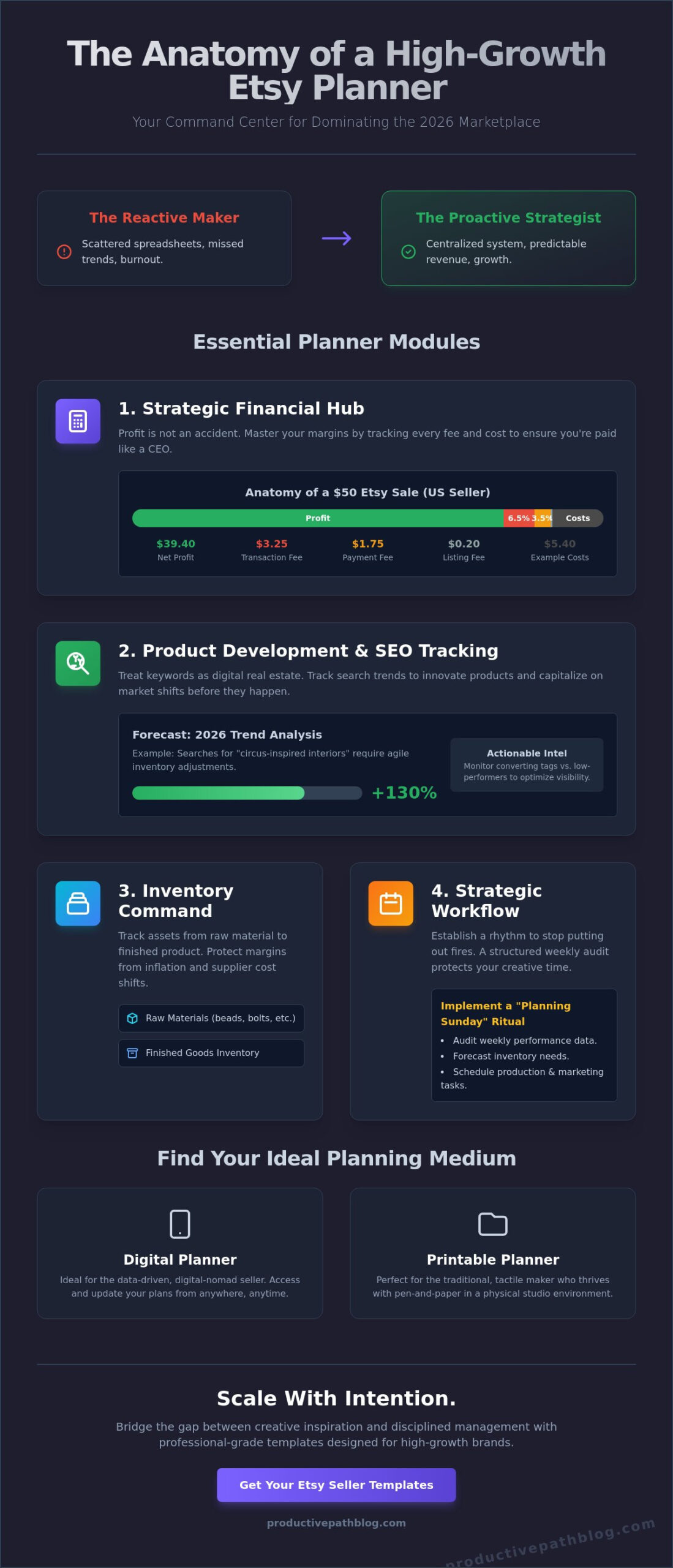
- Transition from a reactive maker to a proactive strategist by treating your shop as a centralized operating system rather than a collection of tasks.
- Master your margins and search visibility using a business planner for etsy sellers designed to track fluctuating keyword trends and raw material costs.
- Establish a “Planning Sunday” ritual to audit your weekly performance and forecast shifts in the 2026 digital marketplace before they happen.
- Identify the ideal medium for your workflow, whether you thrive in a digital-nomad environment or a traditional, tactile maker’s studio.
- Implement professional-grade templates that bridge the gap between creative inspiration and the disciplined management required for high-growth brands.
Beyond the Side Hustle: Why Every Etsy Seller Needs a Strategic Business Planner
The creative spark is what starts an Etsy shop, but strategic discipline is what keeps it alive. For many, the transition from “maker” to “manager” feels like a loss of artistic freedom. It’s actually the opposite. By implementing a comprehensive business planner for etsy sellers, you’re not just organizing tasks; you’re building a centralized operating system that protects your creative time. This psychological shift is essential for long-term sustainability. While the traditional definition of what a business plan is often focuses on securing external funding, the modern digital version is about internal mastery. It’s about moving away from the “feast or famine” cycle that plagues unorganized shops. In 2026, simply having a unique product isn’t enough to survive. The marketplace demands operational excellence. You need to know your numbers, your schedule, and your trajectory with absolute clarity.
The Cost of Disorganization on Etsy
Disorder is expensive. When your shop operates out of scattered notebooks and mental checklists, revenue leaks through the cracks. Inaccurate shipping estimates or failing to account for the 6.5% transaction fee can quietly erode your margins until your “profitable” shop is actually losing money. Beyond the finances, there is a human cost: burnout. Reactive management means you’re always putting out fires instead of building a legacy. You might miss the “Golden Window” for seasonal trends, like the 2026 surge in circus-inspired decor, simply because you didn’t have the foresight to prepare your inventory three months in advance.
Planners as a Tool for Intellectual Growth
A strategic planner serves as a visionary partner. It forces you to audit your current methods and identify the hidden bottlenecks that slow your production. Are you spending too much time on low-margin items? Is your SEO strategy lagging behind Etsy’s latest algorithm shifts? By using data-driven planning, you transform your mindset from passive saving to active strategic growth. This isn’t just about ticking off boxes. It’s about establishing a rhythm where you analyze your business data to make calculated, forward-thinking decisions. You stop guessing and start growing.
The Anatomy of Success: Essential Sections for Your Etsy Business Planner
A comprehensive business planner for etsy sellers is more than a collection of calendar pages. It is a modular framework where each section serves a distinct strategic purpose. To move beyond the “starving artist” trope, you must treat your inventory as capital and your keywords as digital real estate. A truly effective system doesn’t just record what happened; it dictates what will happen next. While learning how to write a business plan is a great starting point for any entrepreneur, an Etsy seller needs more granular, platform-specific modules to thrive in a high-speed digital economy.
Your planner should act as a command center. If you aren’t tracking raw materials versus finished goods, you’re flying blind. Inflation and shifting supplier costs can quietly cannibalize your earnings. By logging every bead, bolt, or digital asset, you protect your margins from the inside out. Furthermore, visibility isn’t a “set it and forget it” game. Search trends for 2026, such as the 130% increase in circus-inspired interiors, require agile adjustments. A dedicated SEO tracker allows you to monitor which tags are converting and which are just taking up space. You can find professionally designed systems that integrate these sections at Productive Path Blog.
The Strategic Financial Hub
Profit is not an accident; it is the result of meticulous calculation. Your financial hub must account for the 6.5% transaction fee, the $0.20 listing fee, and the 3% plus $0.25 payment processing fee that US sellers face. Without these details, your “revenue” is a vanity metric. In the 2026 Etsy ecosystem, your profit margin represents the net percentage of revenue remaining after subtracting the 6.5% transaction fee, $0.20 listing costs, payment processing, and all production overheads. Use pricing calculators that factor in your labor hours to ensure you’re being paid like a CEO, not an intern.
Product Development and SEO Tracking
Growth requires a roadmap for innovation. A robust business planner for etsy sellers includes listing checklists that cover everything from high-resolution photography to alt-text optimization for accessibility. This ensures every product launch is professional and standardized. Use keyword performance logs to identify “unicorn” tags that drive high-intent traffic. By mapping these trends seasonally, you can begin planning your Q4 holiday inventory as early as Q2, ensuring you’re ready when the algorithm shifts toward gift-giving searches. This proactive stance separates the market leaders from the hobbyists.
Digital vs. Printable: Choosing the Right Planning Medium for Your Workflow
Does a digital-first approach outperform a physical binder? It depends on your operational environment. A “Digital Nomad” managing a shop from a laptop while traveling has vastly different needs than a “Maker” working in a dedicated studio filled with raw materials. Choosing the right business planner for etsy sellers requires an audit of your physical workspace and your cognitive style. Digital templates offer unmatched portability and a zero-waste environmental footprint. Conversely, physical pages provide a tactile connection that can spark creative problem-solving during the design phase. While the U.S. Small Business Administration guide emphasizes the structural components of a plan, the medium you choose dictates how consistently you’ll actually engage with your data.
The choice isn’t just about preference; it’s about friction. If you find yourself avoiding your shop’s analytics because opening a spreadsheet feels like a chore, a hyperlinked digital planner might be the solution. If you’re overwhelmed by screen time and digital notifications, a printable binder offers a sanctuary for deep work. Your planning medium should be a bridge to your goals, not a barrier. By aligning your tools with your environment, you ensure that strategic management becomes a natural part of your creative day rather than an administrative burden.
Digital Planners: For the Data-Driven Seller
Digital systems are built for the seller who values speed and scalability. With hyperlinked navigation, you can pivot from your inventory log to your sales forecast in a single tap. This is essential when managing complex data like the 2026 fee updates. Digital templates allow for infinite page duplication. As your shop grows from ten listings to hundreds, your planner expands without adding physical bulk. For those using tablets with a stylus, the experience mimics handwriting while keeping your files searchable and backed up in the cloud. It’s the ultimate tool for the agile entrepreneur who needs their entire office to fit in a backpack.
Printable Planners: For the Tactile Creator
Sometimes, the best way to scale is to unplug. Printable planners offer a “Deep Focus” advantage that screens cannot match. In a studio environment, having a physical “command center” provides immediate visual cues that keep you on track. You aren’t distracted by pings or the temptation to check social media metrics. Handwriting your strategy has been shown to improve memory retention and conceptual thinking. It allows you to sketch out product designs or map out seasonal trends with a freedom that rigid digital grids sometimes restrict. You can customize a physical binder with specialized inserts that match your specific craft, from tracking fabric swatches to monitoring drying times.
Strategic Implementation: Using Your Planner to Forecast 2026 Trends
Execution is where most sellers falter. A business planner for etsy sellers is useless if it gathers digital dust on your hard drive or studio shelf. You need a consistent rhythm. Establishing a “Planning Sunday” ritual allows you to audit the previous week’s statistics without the pressure of active production. This is your time to look at the numbers with a cold, analytical eye. By reviewing your conversion rates and traffic sources every seven days, you identify patterns before they become expensive problems. It’s the difference between being a reactive maker and a proactive CEO who understands the mechanics of their own success.
Monthly trend mapping is equally vital for staying relevant. Etsy’s 2026 ecosystem, now under the leadership of CEO Kruti Patel Goyal, focuses heavily on original designs and product innovation. Your planner should be the place where you track these macro shifts. Use it to anticipate algorithm changes or seasonal surges, such as the rising demand for Patina Blue or the “Modern Cottagecore” aesthetic. If you’re still treating your shop as a part-time project, learning how to organize your side hustle is the first step toward professional scaling. You can’t reach 2026 revenue goals with 2022 habits.
The 90-Day Sprint Framework
Avoid the trap of the “infinite to-do list.” It’s a recipe for paralysis. Instead, pick three core objectives for the quarter to focus your energy. Perhaps you want to reduce material waste or launch a nature-inspired collection featuring Glacial Blue tones. By breaking these high-level goals into weekly actionable tasks, you prevent the overwhelm that leads to burnout. A quarterly planner template acts as a roadmap for personal mastery by providing a structured environment where long-term vision meets daily discipline; it ensures your daily actions align with your ultimate brand identity.
Auditing Your Shop Performance
Every month, perform a cold-blooded audit of your shop’s performance. What worked and why? Identifying “dead weight” inventory is critical for protecting your profit margins. If a listing hasn’t moved in 90 days despite SEO updates, it’s draining your resources and mental energy. Use your planner to track these laggards and decide whether to restyle, discount, or delete them entirely. Adjust your strategic roadmap based on this real-world feedback rather than emotional attachment to a specific design. To start your transformation with professional-grade tools, explore our collection of templates at Productive Path Blog.
Scaling with Intention: How Productive Path Blog Templates Empower Your Shop
Strategic growth requires more than ambition; it requires a reliable infrastructure. Our design philosophy at Productive Path Blog centers on the belief that a business planner for etsy sellers should act as a bridge. It connects the creative “messy-middle”: that phase where ideas are abundant but execution is fragmented, to a level of corporate-grade organization. We don’t provide just layouts. We provide frameworks that evolve alongside your brand. Whether you’re celebrating your first sale or managing a catalog that generates 1,000 transactions, these tools scale with you. With instant-access downloads, you can begin this transformation today. You don’t have to wait for a new year to start acting like a market leader. Proactive planning is the antidote to the chaos of a growing business.
Designed for Entrepreneurs, by Strategists
Staring at a blank page is the quickest way to kill momentum. Our pre-structured layouts eliminate this “blank page syndrome” by guiding you toward high-impact tasks immediately. We focus on the levers that actually move the needle: inventory turnover, keyword conversion, and profit retention. By integrating habit tracking into your daily workflow, our templates help you build the ironclad discipline of a top-tier seller. You stop doing busy work. You start doing the work that builds wealth. This is about transforming your shop into an asset that works for you, rather than a job that consumes you. It’s a shift from being an employee of your own creativity to being the visionary behind a profitable enterprise.
Your Next Steps Toward Mastery
The first step toward a more profitable 2026 is an honest audit. Look at your current planning tools: what is costing you time? If you’re manually calculating fees or searching through old notebooks for supplier details, you’re losing money. Select the right template for your current business stage to regain control of your schedule and your margins. Don’t let another season of high-demand trends pass you by because of a lack of foresight. Your shop deserves a roadmap that matches your potential. Explore our curated collection of business planner templates and claim your seat at the head of the modern digital marketplace. The future of your brand starts with the system you implement today.
Architecting a High-Growth Brand: Your Path to 2026 Dominance
The digital landscape doesn’t wait for the unorganized. To thrive in the 2026 economy, you must move beyond the side hustle mentality and embrace a framework that prioritizes operational excellence. We’ve explored how a centralized business planner for etsy sellers transforms raw data into actionable insights: protecting your margins from fee shifts and ensuring you hit every seasonal trend window with precision. Whether you choose the tactile focus of a printable binder or the agile speed of a digital template, the goal remains the same: clarity. Absolute, unwavering clarity.
Success isn’t about working harder; it’s about working with a superior roadmap. By implementing the Planning Sunday ritual and the 90-day sprint framework, you replace reactive chaos with visionary growth. You have the talent. You have the craft. Now, you need the system to support it. Your brand’s potential is too significant to leave to chance.
Ready to elevate your operations? Scale your Etsy shop with our professional planner templates. Our collection features professional-grade strategic layouts with instant digital download and access, specifically designed for the 2026 digital economy. Don’t just make products. Build an empire.
Frequently Asked Questions
Do I really need a business planner for a small Etsy shop?
Yes, because strategic organization is the primary catalyst for growth. Even a shop with a handful of listings must navigate complex fee structures, inventory cycles, and search algorithm shifts. A business planner for etsy sellers acts as a centralized operating system; it ensures you’re making data-driven decisions rather than reacting to pings in your inbox. Without a system, a shop remains a hobby. With one, it becomes a scalable brand.
What is the difference between a digital planner and a printable one for Etsy?
The choice depends entirely on your workspace and cognitive style. Digital planners offer hyperlinked navigation and infinite scalability on tablets, making them ideal for the “Digital Nomad” seller. Printable planners provide a tactile, screen-free sanctuary that can improve memory retention and creative focus. Many makers prefer the physical binder as a “command center” in their studio to avoid the distractions of digital notifications.
How can a planner help me improve my Etsy SEO?
A planner provides a dedicated space to track keyword performance and search shifts over time. Instead of guessing, you log which tags drive actual conversions and monitor seasonal trends months in advance. This structured tracking allows you to identify “unicorn” keywords that competitors might miss. It transforms SEO from a mysterious hurdle into a manageable, iterative process based on real-world evidence.
Can I use these planner templates for other platforms like Shopify?
Absolutely. While the templates are optimized for Etsy’s specific nuances, the core business logic remains universal. The inventory management, financial forecasting, and marketing hub sections are essential for any e-commerce platform. You can easily adapt the strategic frameworks to manage a Shopify storefront, Amazon Handmade shop, or even a local craft fair circuit.
How often should I update the financial section of my business planner?
You should perform a brief weekly audit and a comprehensive monthly deep-dive. A “Planning Sunday” ritual ensures you catch revenue leaks, like unexpected shipping costs, before they erode your margins. Monthly updates allow you to analyze your net profit after all fees and taxes are accounted for. This regular cadence prevents financial “surprises” and keeps your growth on a predictable trajectory.
What are the most important sections every Etsy seller should have in their planner?
Every effective business planner for etsy sellers must include an inventory tracker, a financial hub for fee calculations, and an SEO keyword log. These are the three pillars of a healthy shop. Additionally, you should maintain a customer experience log to manage repeat buyer strategies and a seasonal trend forecaster to stay ahead of the marketplace’s shifting demands.
How do I start planning if I’m already overwhelmed by my shop’s daily tasks?
Start small by identifying your three most impactful objectives for the next 90 days. Don’t try to overhaul your entire business in a single afternoon. Use pre-structured templates to eliminate the “blank page” syndrome and focus on one high-impact section at a time. Once you protect your margins and stabilize your workflow, the daily overwhelm naturally begins to dissipate.
Are digital planner templates compatible with all tablets and apps?
Most digital templates are delivered as high-quality PDF files with interactive hyperlinks. This format is compatible with any tablet that supports a stylus and a PDF annotation app. Popular choices include GoodNotes and Notability for iPad users, or Xodo for Android enthusiasts. Always ensure your chosen app supports hyperlinked PDFs to get the full benefit of the planner’s navigation system.