
Why 2026 Is Different: AI, Local Trust and Micro-Scale Specialisation
2026 feels less like a new decade and more like a correction: commoditised gig work has thinned, while highly targeted micro-skills and human-trust services have soared. This section sets the stage with a concrete claim: the most lucrative side hustles in 2026 are those that combine AI-enabled productivity with a genuine human differentiator — local trust, specialised craft or regulatory knowledge.
Many successful part-timers no longer sell time alone. They sell time amplified by tools (AI assistants, automation, vertical marketplaces) and anchored by credibility (local reputation, certifications, deep niche knowledge). Expect case studies below to show hybrid models: AI for scale, humans for quality control and relationship-building.
Case Study: Maya — From Primary-School Teacher to AI-Powered Micro-Tutor
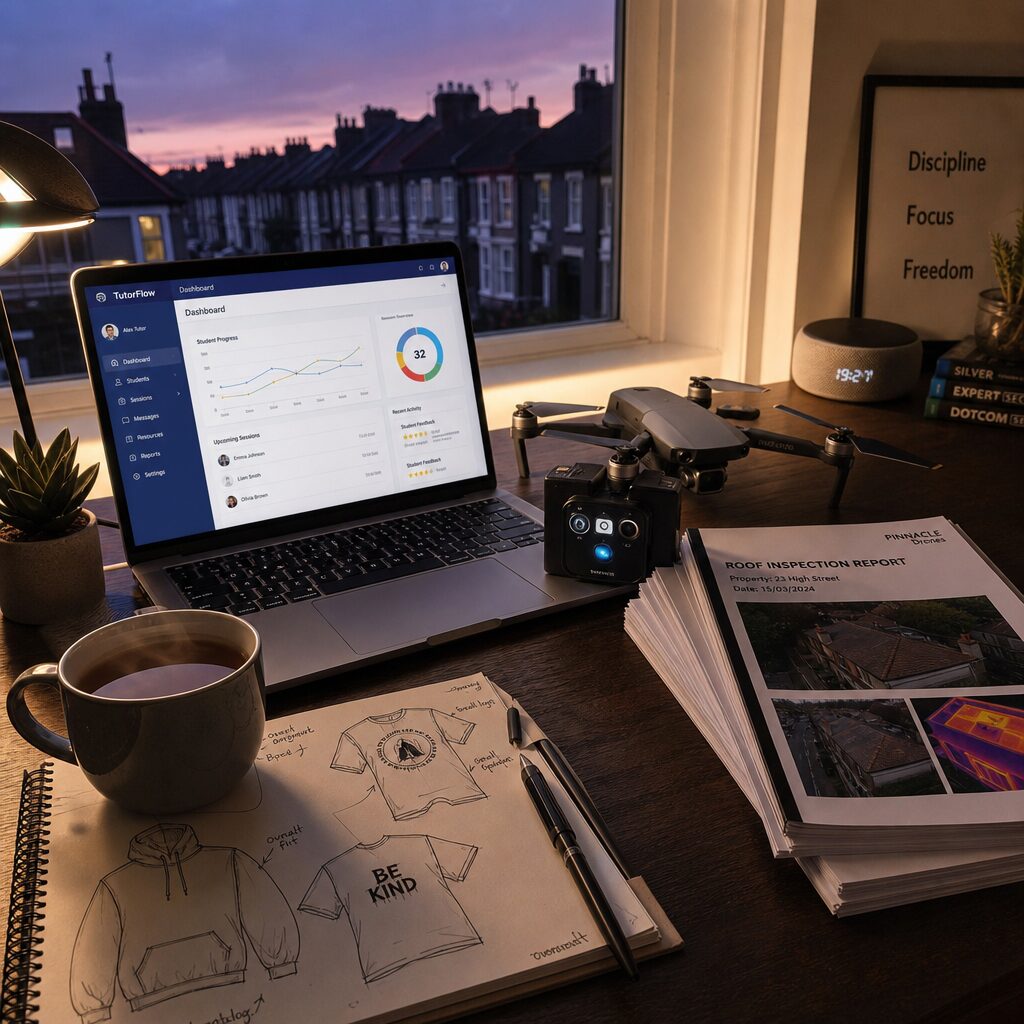
Maya, a primary-school teacher in Brighton, began tutoring after-hours in 2023. By 2026 she earns an extra £2,200 a month, not through more hours but by redesigning her offer. She built a 12-week micro-course for Year 6 SATs that pairs short live sessions with bespoke AI-generated practice packs. Maya uses a paid tutoring platform to schedule and handle payments, and a prompt-engine tool to create differentiated worksheets that adapt to each pupil’s errors.
Her edge: trust and standardised outcomes. Parents value her teaching credentials and the data trail showing improvement. Maya automated 60% of her prep time with templates and an AI marking assistant, freeing her to take on more students without burnout. She reinvested earnings in a simple landing page and a local partnership with two primary schools, turning one-off clients into waiting lists.
Case Study: Omar — Drone Inspections and a £30k Side-Project Turned Ltd
Omar, a civil engineer in Manchester, started doing drone roof inspections evenings and weekends in 2024. By 2026 the side job is a limited company bringing in £32k a year. His success came from specialising: not general aerial footage but thermal-assisted inspections for condensation and insulation defects for tenanted properties — a niche that small landlords and letting agents urgently need post-energy-regulation changes.
He combined off-the-shelf drones, a subscription thermal sensor, automated flight plans and a templated report generator. Omar outsourced photo editing to a freelancer and built a referral pipeline with two local estate agents. Crucially, he invested in insurance and compliance training early, which let him win contracts that hobbyist pilots couldn’t touch.
Case Study: Laila — Niche Print-on-Demand Meets Community Curation
Laila, a graphic designer in Cardiff, turned a part-time print-on-demand hobby into a £1,000 monthly income by 2026. Her twist was community curation: instead of broad designs she created limited-run collections for local micro-communities — rowing clubs, bookshops, indie record stores. She launched small batches via pop-ups and a Shopify store, using AI to prototype concepts quickly and A/B test on social ads.
Revenue came from scarcity and localisation rather than volume. She kept unit margins high by partnering with a UK fulfilment centre for fast shipping and offering personalised options. Her designs also fed into a subscription ‘design drop’ for three clubs who pay monthly for exclusive motifs — a recurring revenue model that turned casual buyers into steady patrons.
How These Hustles Scaled: Common Threads and Tactical Moves
Across these stories, five tactics recur: specialise narrowly; use AI and templates to automate routine work; anchor offers with local or professional trust; build recurring revenue where possible; and invest early in compliance or quality signals (insurance, certification, curated portfolios).
Tactical checklist: carve a micro-niche rather than compete in a broad market; automate repeatable outputs with AI but keep a human QC step; design a simple funnel (lead capture, proof-of-work, small paid offer); create at least one recurring product (membership, subscription packs, retainer); and make compliance a selling point if your niche touches safety or regulation.
Unexpected Wins and Cautions From Real Hustlers
Unexpected wins: pricing power often derives from scarcity and story, not low cost — Maya and Laila charged premiums by promising outcomes or exclusivity. Secondary income streams (reports, templates, community subscriptions) multiplied revenue beyond billable hours.
Cautions: platform risk and legal exposure are real. Omar’s step of forming an Ltd and buying specialist insurance cost time and money but unlocked higher-value clients. Over-reliance on a single marketplace or social channel is fragile; diversify lead sources early. And ethical use of AI matters — transparent communication about automated elements preserves trust.
Blueprint: How to Prototype Your Own 2026 Side Hustle in 90 Days
Week 1–2: Validate demand. Talk to five paying customers or partners in your target niche. Build a one-page offer and price it.
Week 3–6: Build the stack. Set up booking/payment, choose AI tools or automation, and create one repeatable deliverable template.
Week 7–10: Launch and iterate. Run three small paid pilots, collect feedback, and refine your delivery workflow.
Week 11–12: Institutionalise. Automate 40–60% of prep tasks, set up a simple CRM, and draft basic terms, pricing tiers and an onboarding checklist. If the numbers look promising, formalise insurance or business structure.
Final Takeaway: Side Hustles as Mini-Businesses, Not Gigs
The line between side hustle and small business has blurred. In 2026, the best extra-income projects are conceived as scaled micro-businesses: specific, automatable, trust-anchored and recurrence-friendly. The case studies above show you don’t need revolutionary tech to win — you need focus, repeatability and the courage to treat a weekend idea as a real enterprise.
![Como viver com menos do que você ganha [sem se sentir miserável]](https://productivepathblog.com/wp-content/uploads/2026/05/How-to-Live-Frugally-PTqOcG-559x1024.jpg)
