
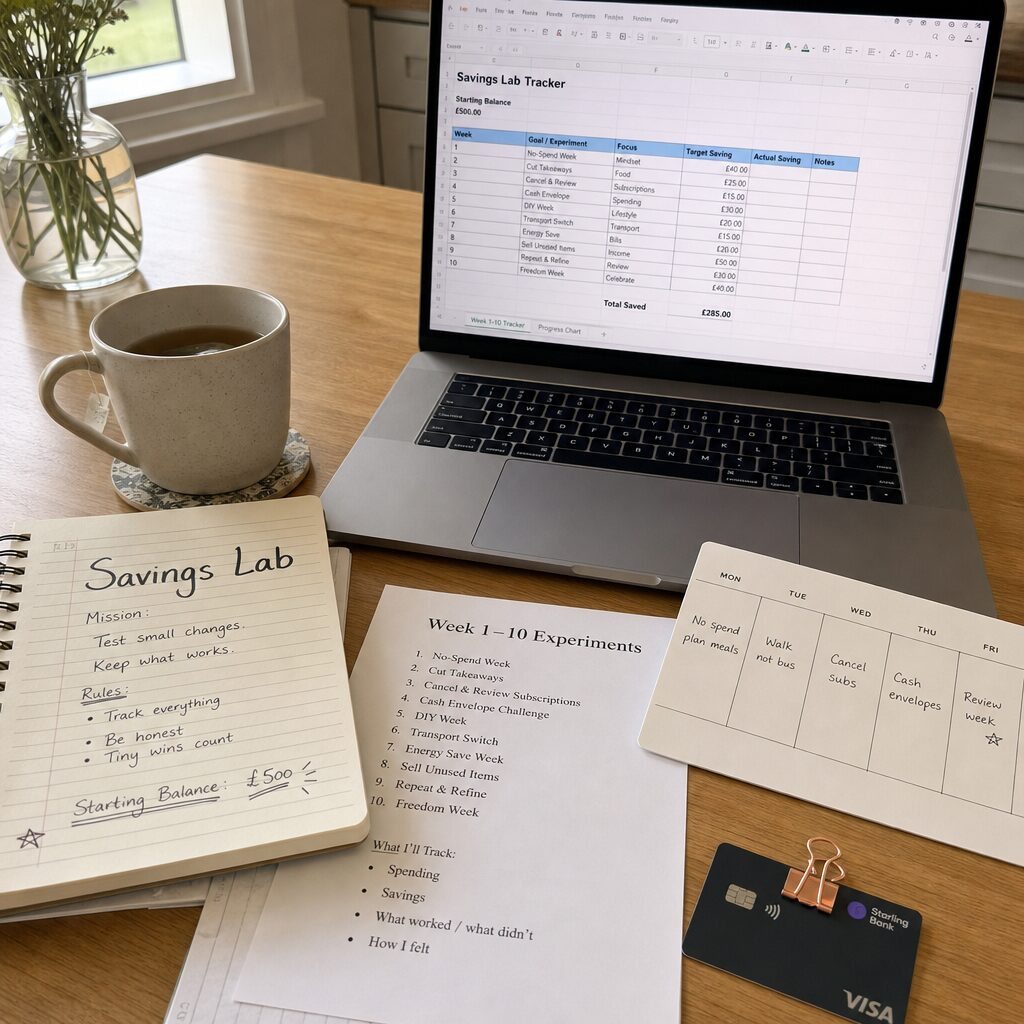
Why this guide is different: treat saving as a beginner’s lab
Most “10 ways to save” lists end up feeling abstract or preachy. This guide reframes saving as a beginner’s laboratory: ten repeatable experiments you can run, one at a time, to discover what actually works for you. Each experiment has a clear first step, a tiny habit to form, a way to measure success in a month, and a low-risk rollback if it doesn’t stick. That approach reduces overwhelm and turns saving into curiosity rather than austerity.
Think of your first 30 days as a tenure of trials. Don’t aim for perfection. Aim for detectable change—an extra £50, £100 or even just a clearer view of your spending. The point is to learn, not to punish yourself.
How to use this guide: the 10-week starter plan
Begin with one experiment per week for ten weeks, or combine complementary ones if you prefer faster progress. Each week follows three simple steps: set a single micro-goal, implement a one-time action, and track the result. Keep a two-column log—actions on the left, outcomes (money saved and how it felt) on the right.
If you want immediate structure, print or duplicate this plan into your notes app and add calendar reminders: “Week 1: Subscription audit” or “Week 4: Grocery batch-cooking trial.” The schedule is flexible; the habit is cumulative.
Experiment 1 — Subscription audit: the 20-minute elimination
Why it matters: recurring subscriptions are stealth drains, often set-and-forgot. The first experiment is to conduct a 20-minute audit of direct debits and recurring card payments.
Starter action: list every monthly payment from the last three bank statements, then ask three questions for each: Do I use it? Could I replace it with a cheaper option? Would cancelling save enough to matter? Cancel or pause one service and set a calendar reminder to reassess in three months.
Success metric: money freed in month one and emotional relief at owning control. Bonus hack: negotiate price or annual discount where possible; don’t assume cancellation is the only option.
Experiment 2 — Zero-based mini-budget: allocate every pound
Why it matters: beginners often misinterpret budgeting as restriction. A zero-based mini-budget assigns every pound a role for the month, including saving. It teaches intent instead of deprivation.
Starter action: choose a single pay period, allocate income to essentials, a small discretionary pot, and a defined saving line (even £10). Use a simple spreadsheet or a dedicated app and label the saving pot with a motivating goal.
Success metric: a visible line named “saving” on your budget. Psychological trick: give the pot a short-term name—”Holiday fund” or “Buffer”—to make the reward tangible.
Experiment 3 — Automate your future self: the simplest autopilot
Why it matters: willpower fades; automation preserves intent. Set up an automatic transfer to your savings account on payday, even if it’s small.
Starter action: arrange a standing order the day after pay day for an amount you won’t notice (start at 3–5% of net pay). Treat that transfer as untouchable for 30 days.
Success metric: the balance ticked up without conscious effort. If it stings, reduce the amount rather than stopping—retain the psychology of “paying your future self.”
Experiment 4 — The renegotiation script: save by asking
Why it matters: many savings exist behind a simple conversation. Bills, broadband, insurance and even rent can be reduced if you ask or threaten to walk.
Starter action: pick one recurring bill and make one call or use live chat. Use a short script: “I’m reviewing costs and considering switching. I’d prefer to stay—do you have loyalty discounts or a cheaper plan?” Note the outcome and time spent.
Success metric: a reduced monthly bill or a clear reason why the supplier can’t help. The big insight: negotiation is a skill; the first call is practice.
Experiment 5 — Energy micro-adjustments: small actions, steady returns
Why it matters: energy savings compound every month and are low-effort. Focus on habits rather than major home upgrades to start.
Starter action: adopt three micro-adjustments for 30 days: reduce thermostat by 1°C, use an LED timer for appliances, and unplug chargers overnight. Track meter readings or compare bills month-to-month.
Success metric: a measurable dip in your energy use or an estimated monthly saving. Keep the ones that are painless and integrate them into your routine.
Experiment 6 — Smart grocery savings: plan, batch, revalue
Why it matters: food is a large, negotiable part of monthly spend. The beginner’s edge is not extreme couponing but pragmatic planning.
Starter action: pick three recipes you like and create a single shopping list for two weeks. Buy one multi-use ingredient that replaces several buy-once items. Commit to one batch-cook day.
Success metric: reduced food waste, fewer impulse buys and an immediate drop in weekly spend. Convert leftover meals into a labeled fridge zone so they don’t vanish into mystery.
Experiment 7 — The 48-hour cooling rule for discretionary spend
Why it matters: impulse purchases erode the best budgets. A simple pause reduces regret purchases and increases mindfulness.
Starter action: for one month, adopt a 48-hour rule on non-essential purchases above a set threshold (e.g. £30). Use a wish list app or note to revisit the item after the cooling period.
Success metric: fewer impulse buys and clearer priorities. Often, desire fades; money saved is the secondary reward.
Experiment 8 — Community swaps and micro-economies
Why it matters: saving isn’t only about cutting costs—it can be about accessing value differently. Swapping, borrowing and sharing reduce duplication.
Starter action: join a local Facebook group, Freecycle or tool library. Offer one item to swap and ask to borrow one tool or item for a specific task.
Success metric: money not spent and new local connections. Social capital often turns into practical savings later, especially for occasional needs.
Experiment 9 — Digital declutter: cancel app clutter and mixed payments
Why it matters: unused apps, trial renewals and multiple payment methods hide recurring costs and friction.
Starter action: audit phone subscriptions, remove auto-fill card details from stores you rarely use, and consolidate purchases onto one card for easier tracking.
Success metric: fewer surprise charges and clearer monthly statements. The tidy digital life reduces cognitive load and friction when tracking spending.
Experiment 10 — Convert saved time to value: monetise or reallocate
Why it matters: savings create time as well as money. Treat time saved from efficiency as a tangible resource—either convert to cash or reinvest in wellbeing.
Starter action: calculate an hourly value for your time (even a conservative figure). If a saving frees up two hours a week (no queueing, batch-cooking), decide whether to freelance, upskill or rest. Track how you use that time and its monetary equivalent over 30 days.
Success metric: a conscious decision about time use. The beginner realisation is that not every saved minute must be monetised; some add life value and reduce spending indirectly.
Tracking, troubleshooting and the six-week review
After your first six experiments (or six weeks), conduct a structured review. Look for: which experiments saved the most, which felt hardest to maintain, and which created unexpected benefits (less stress, clearer priorities).
Troubleshooting tips: if an experiment fails, ask whether the action was too big, the reward unclear, or the timeline unrealistic. Reduce the scale and try again. Celebrate small wins—each pound retained is progress.
Next steps: keep the sustainable experiments, shelve the rest for future attempts, and plan a second ten-week round focused on scaling what worked.
Final note: start with curiosity, finish with a system
Beginners who treat saving as experiments make faster, kinder progress. You’ll learn your friction points, discover personalised hacks and build a modest but reliable system. Over time, these tiny, consistent changes compound into meaningful cushions—financially and mentally.
Set a simple pledge now: choose your first experiment and schedule the initial action within 24 hours. The act of starting is the most consistent predictor of long-term saving.
![Como viver com menos do que você ganha [sem se sentir miserável]](https://productivepathblog.com/wp-content/uploads/2026/05/How-to-Live-Frugally-PTqOcG-559x1024.jpg)
