
Why 2026 Is the Year for Strategic Side Hustles — Not Random Gigs
2026 is different: AI tools, platforms, and a hybrid economy mean side hustles must be designed as short businesses, not ad-hoc jobs. Beginners often chase “top trending” gigs and burn out. Instead, think in systems: choose a small, repeatable offer that leverages a single skill plus one enabling tool (AI, marketplace, or low-code). This section explains why that pairing — skill + tool — is the core unit of modern side hustles and how it reduces startup friction, increases margin and scales into a part-time enterprise.
Start by inventorying your real assets: 1) discoverable skills (what people will pay for), 2) time you can reliably commit per week, and 3) access to tools or communities (platforms, AI subscriptions, local networks). The rest of the guide turns that inventory into a 90-day launch plan that’s realistic, measurable and beginner-friendly.
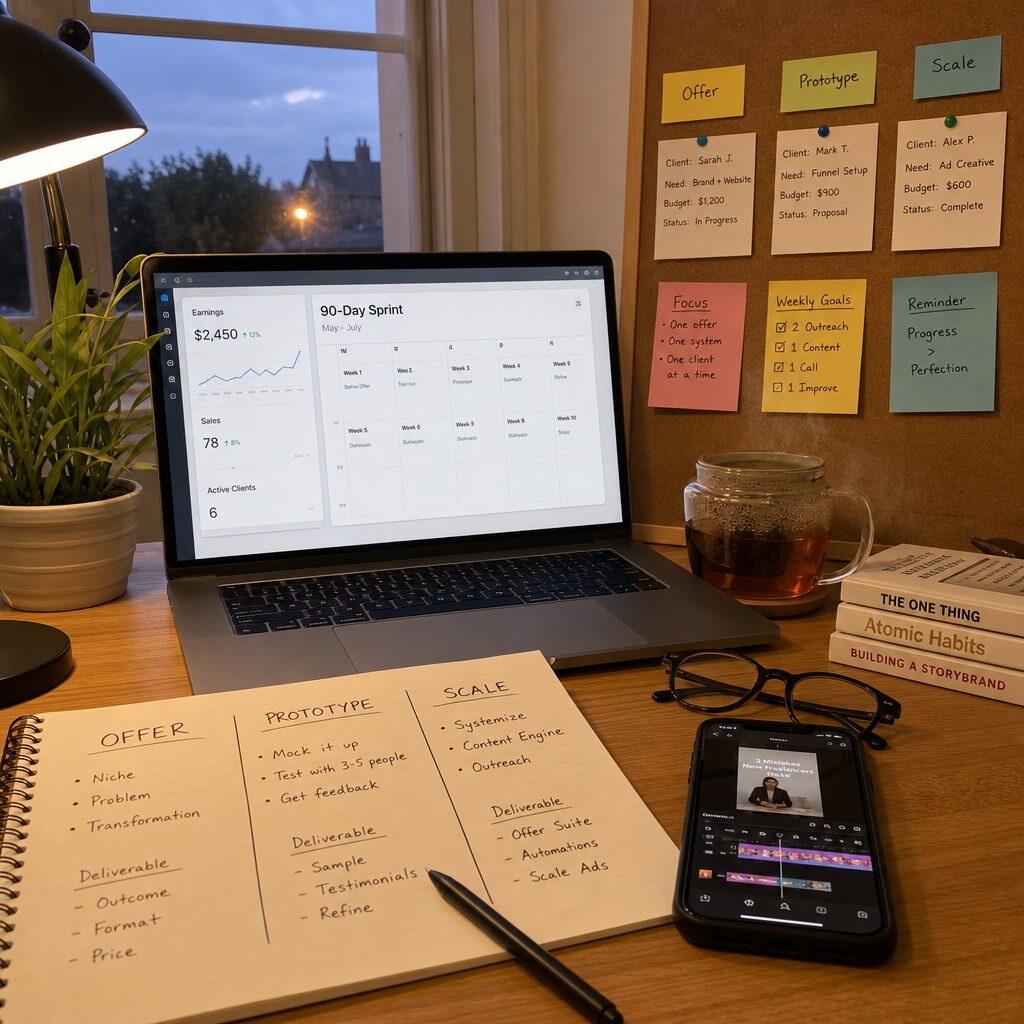
Choose Your 90-Day Side Hustle Sprint: A Practical Framework
Forget vague lists. Pick one of three sprint types based on risk and effort: “Skill-Stack Sprint” (monetise a current skill fast), “Learn-and-Ship Sprint” (learn one vetted micro-skill and create an offer), or “Productise Sprint” (turn repeat work into a productised service). Each sprint follows the same structure: Week 1 — niche and offer; Weeks 2–4 — prototype and lowest-effort marketing; Weeks 5–8 — refine and automate; Weeks 9–12 — scale and set systems.
Concrete example: a teacher (Skill-Stack Sprint) packages 1:1 exam tutoring into a three-session “exam rescue” product, uses AI to generate practice tests, lists on a tutoring marketplace and advertises in local parent groups. Pricing and outreach are decided in Week 1; client fulfilment and simple automation (scheduling, payment) come in Weeks 2–4.
Nine Proven Side Hustles Reimagined for 2026 Beginners
This is not a generic list — each hustle comes with a one-sentence angle that makes it accessible for a novice and suited to 2026 realities.
– AI-Enhanced Micro-Consulting: Offer short, outcome-focused consultations (30–90 minutes) supplemented by AI-generated reports. Beginners can charge premium rates because of high perceived value.
– Niche Digital Courses for Micro-Audiences: Create a 60–90 minute course solving one pain point; host on marketplaces or sell direct. Use short-form video for marketing.
– Localised On-Demand Services: Combine a local need (garden maintenance, elderly tech support) with online bookings and automated reminders.
– Content Repurposing Service: Many creators need multi-platform versions of one video or article — you offer the polished repackaging using AI editing tools.
– Low-Code Applets and Automations: Build small automations for local businesses (booking flows, invoice triggers) using no-code tools.
– Specialty E-commerce Dropshipping with Brand Edge: Sell small-batch, well-branded products via tight social funnels; avoid generic marketplaces.
– Creative AI Prompts & Templates Shop: Sell industry-specific prompt packs, templates or micro-assets for creators and professionals.
– Micro-Events and Workshops: Host paid neighbourhood or online workshops focused on high-demand skills (resume sprints, AI tools 101).
– Subscription Micro-Services: Offer a capped-hours monthly retainer for small businesses (social posts, copy edits, customer replies).
A Beginner’s Toolkit: Tools, Costs and Minimal Setup
You don’t need expensive gear. Prioritise a small, modular toolkit with predictable costs:
– Communication & bookings: Calendly alternatives, WhatsApp/Signal, or a simple website.
– AI & productivity: A single reliable AI subscription (choose domain-relevant models), plus a note-taking sync like Obsidian or Notion.
– Payments: Stripe, PayPal, or local equivalents; set clear refund and cancellation policies.
– Marketing: Short-form video apps, a basic email tool and one marketplace listing.
Estimate the realistic first-month spend: £20–£120 for subscriptions, £0–£50 for marketing tests, and time investment of 5–15 hours per week. Keep cashflow conservative and track every sale; early profit validates the model.
Launch Playbook: First Client in 14 Days
A fast, repeatable playbook to land your first paying client within two weeks:
Day 1–2: Define a specific offer (outcome, target customer, price). Day 3–4: Create a one-page pitch and one-sheeter or short demo. Day 5–7: Reach out to 20 targeted prospects via personalised messages (local groups, LinkedIn, marketplaces). Day 8–10: Run two low-cost ads or test three short videos. Day 11–14: Deliver a paid trial or discount-first client and request testimonials.
Use an early-bird pricing strategy to reduce friction. Aim to overdeliver on the first order and automate one administrative step (invoicing, scheduling) before taking the second client.
Managing Time, Taxes and Burnout for New Hustlers
Beginners often underestimate administrative load. Set boundaries: two fixed work slots weekly and a strict limit on client numbers until processes are automated. Use simple financial rules: retain 25% of revenue for taxes, 10% for reinvestment, and track all expenses in a single spreadsheet.
Understand tax basics in the UK: register as self-employed within three months of earning, keep receipts, and use MTD-compatible software if VAT applies. For mental health, schedule one weekly non-work block and adopt the “two-week experiment” mindset — try something short and stop if it burns you out.
Scaling Without Quitting Your Day Job: When and How to Transition
You don’t need to quit to scale. Decide on transparent milestones to guide a transition: consistent monthly net income equal to 25–50% of your salary, repeatable client acquisition without your constant input, and a reserve fund of three months’ expenses. When those conditions are met, run a 90-day transition plan: increase marketing, systematise delivery, hire a part-time contractor and formalise contracts.
If you aim to convert the hustle into a full-time business, document every process in plain language so it can be delegated. Use simple KPIs: client retention rate, average order value and time-per-client.
Common Beginner Mistakes and How to Avoid Them
Avoid chasing novelty, underpricing, and building in isolation. Do these instead: validate with a paying customer before refining your offer, price for value not time, and join one focused peer group for feedback. Keep a failure log: record what didn’t work, why, and what you changed — it speeds learning.
Finally, treat your side hustle as a product: iterate quickly, measure outcomes, and stop anything that doesn’t show early signs of traction.
![Como viver com menos do que você ganha [sem se sentir miserável]](https://productivepathblog.com/wp-content/uploads/2026/05/How-to-Live-Frugally-PTqOcG-559x1024.jpg)
