
The Hidden Problem: Financial Identity Drift
Most articles frame side hustles as cash generators. They rarely discuss how a side income preserves — and even reshapes — your financial identity. When people rely on a single employer for years, their sense of financial competence atrophies: they stop negotiating, stop experimenting with pricing, and lose confidence in money decisions. A well-chosen side hustle reverses that drift. It forces you to set prices, invoice customers, manage small-scale marketing and evaluate profitability. Those seemingly mundane tasks rebuild financial muscle memory, so when you face a pay cut, redundancy or a career pivot you are not starting from scratch.
Beyond practical skill-building, the psychological effect is profound. Running a weekend consultancy or selling niche digital products gives immediate feedback loops — what sells, what doesn’t — that retrain your risk tolerance and decision-making speed. In 2026, with AI tools lowering the barrier to entry for many gigs, side hustles become laboratories for rebuilding a resilient financial identity rather than mere pocket money schemes.
Mitigating Career Obsolescence in an AI-First Market
AI adoption has accelerated role churn across industries. People worry about lay-offs but seldom consider the second-order problem: atrophied domain expertise that makes reinvention painful. Side hustles centred on learning-adjacent tasks — such as consulting on human-centred design, content curation, or community moderation — provide a low-risk way to stay current with market trends.
These micro-businesses compel you to adopt new tools, translate abstract technological changes into customer-facing value, and document processes. That combination of skills is precisely what employers and clients prize in 2026: people who can bridge legacy practice and emerging AI workflows. In short, the right side hustle acts as a continuous retraining plan that keeps you employable and adaptable.
Repairing the Invisible Credit and Lending Gap
A surprising problem many overlook is the way side hustles improve access to credit and capital. Traditional lenders often favour borrowers with diversified income streams and demonstrable self-employment revenue. A consistent side income, even modest, can stabilise cash flow statements, reduce loan-to-income ratios and therefore improve mortgage or small-business loan prospects.
People who pay down debt or build emergency buffers from side earnings also lower their perceived risk to lenders. And for those seeking micro-investment in entrepreneurial ideas, a proven revenue record from a side hustle can be a decisive signal to investors or crowdfunders that you can execute — a form of credibility that salary statements alone rarely provide.
Emotional Insurance: Reducing Decision Paralysis and Burnout
Many view side hustles as hustle culture fuel; but the opposite can be true when approached strategically. A predictable, interest-aligned side income provides emotional insurance. Knowing you have an alternative income stream reduces anxiety about raising concerns at work, saying no to toxic projects, or taking sabbaticals to recharge.
This psychological cushion lowers chronic stress and reduces decision paralysis: you make clearer choices because your livelihood isn’t binary. Side hustles that align with passion or values — teaching a craft, gardening consultancy, or ethical e-commerce — provide restorative work that offsets the emotional toll of primary employment, thus combating burnout in ways that a simple savings account cannot.
Community Currency and Local Resilience
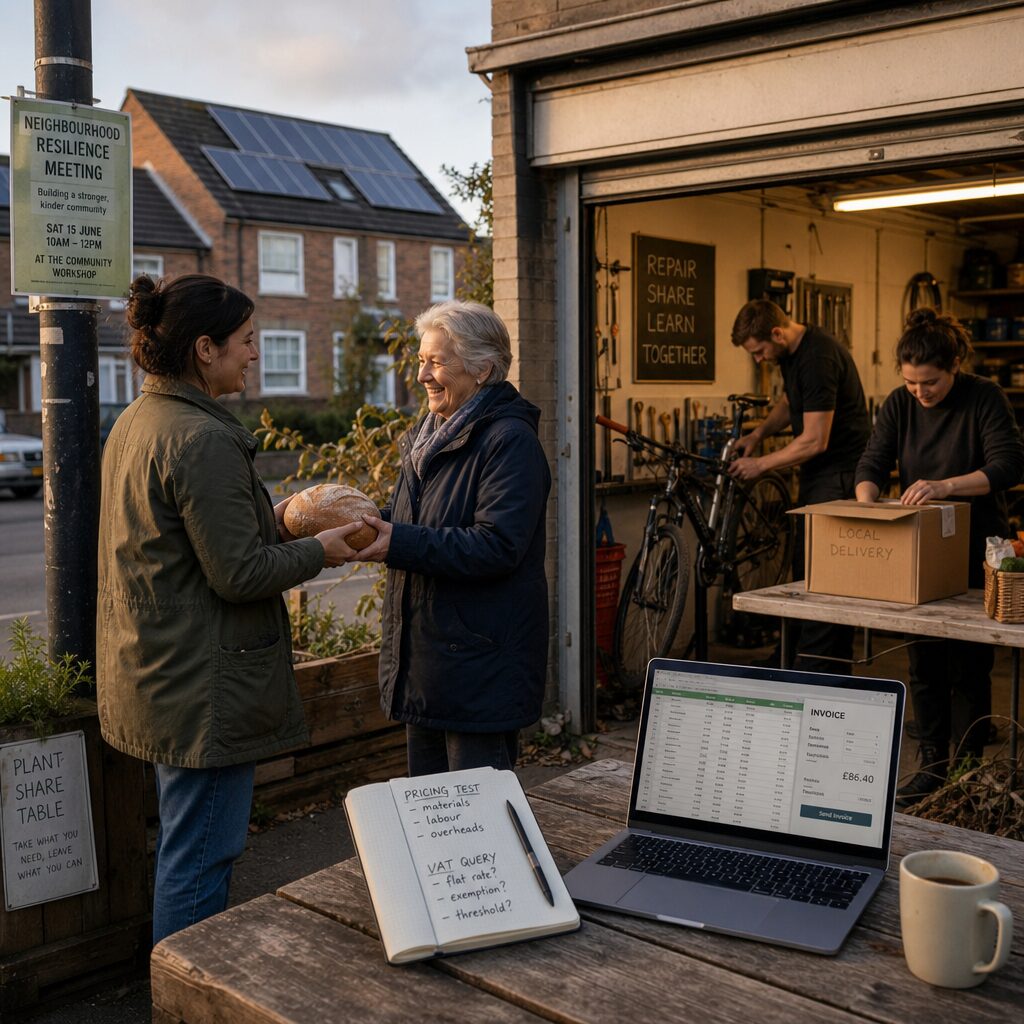
Beyond individual benefits, side hustles knit stronger local economies. When residents run small services — repair workshops, tutoring co-ops, bespoke catering — they create informal networks of barter, referral and mutual aid that conventional GDP measures miss. These micro-economies increase local resilience to supply-chain shocks and climate events by keeping skills and resources within the community.
In 2026, with climate-related disruptions more common, side hustles that provide practical neighbourhood services become de facto resilience infrastructure. They solve the overlooked problem of social capital erosion, rebuild trust, and create rapid-response capabilities that formal institutions often lack.
Tax Literacy and Strategic Financial Planning
A less glamorous but high-impact problem side hustles solve is tax literacy. Many full-time employees are passive tax payers; they do not engage with deductions, allowable expenses or pension optimisation. Running even a micro-business forces you to learn invoicing, allowable expenses, VAT thresholds and pension contributions — knowledge that can materially increase after-tax income.
This literacy also enables strategic planning: using side-earnings to top up pensions, fund ISAs, or time capital gains realisation. The result is not just extra money but smarter money management that compounds over decades, which typical side-hustle lists seldom stress.
Exit Strategy Engineering: Side Hustles as Controlled Experiments
Most people don’t frame side hustles as exit strategy labs. Yet they are ideal for controlled experiments in entrepreneurship. Instead of risking a full-time business launch, you can test demand, pricing, and operational models on a small scale, iterate, and learn while sheltered by your main income.
This reduces moral hazard and catastrophic failure risk. The data you collect — customer feedback, conversion rates, unit economics — becomes a blueprint if you scale. That makes transitioning out of a job cleaner and more evidence-based. In essence, side hustles create optionality: the ability to exit with a viable, validated business rather than a leap into uncertainty.
Practical Next Steps for Choosing the Right Side Hustle
Choose with the problems above in mind, not just immediate cash. If your goal is to rebuild financial identity, pick work that forces pricing and negotiation (consulting, freelancing). To combat obsolescence, choose projects that require new tool adoption (AI-assisted content creation, automation services). For tax and credit benefits, prefer ventures with regular invoicing and documented revenues (subscription services, tutoring). And if community resilience matters, think hyperlocal services (repair cafés, delivery co-ops).
Start with a three-month experiment: track time, revenue, skills learned and emotional impact. Use simple metrics — customer retention, net profit per hour, and stress levels — to decide whether to scale, pivot, or fold. The right side hustle should solve a hidden problem you actually have, not the one you think you ought to.
![Como viver com menos do que você ganha [sem se sentir miserável]](https://productivepathblog.com/wp-content/uploads/2026/05/How-to-Live-Frugally-PTqOcG-559x1024.jpg)
