
A business plan isn’t a document for a bank; it’s an operating system for your limited time. Most side hustlers stall because they’re buried under 40-page manifestos they’ll never actually read. If you’ve felt paralyzed by information overload or the fear of risking your savings, you aren’t alone. Balancing a 9-to-5 with a new venture requires a surgical approach to strategy. You need a side hustle business plan template that functions as a tactical map rather than a weight in your desk drawer.
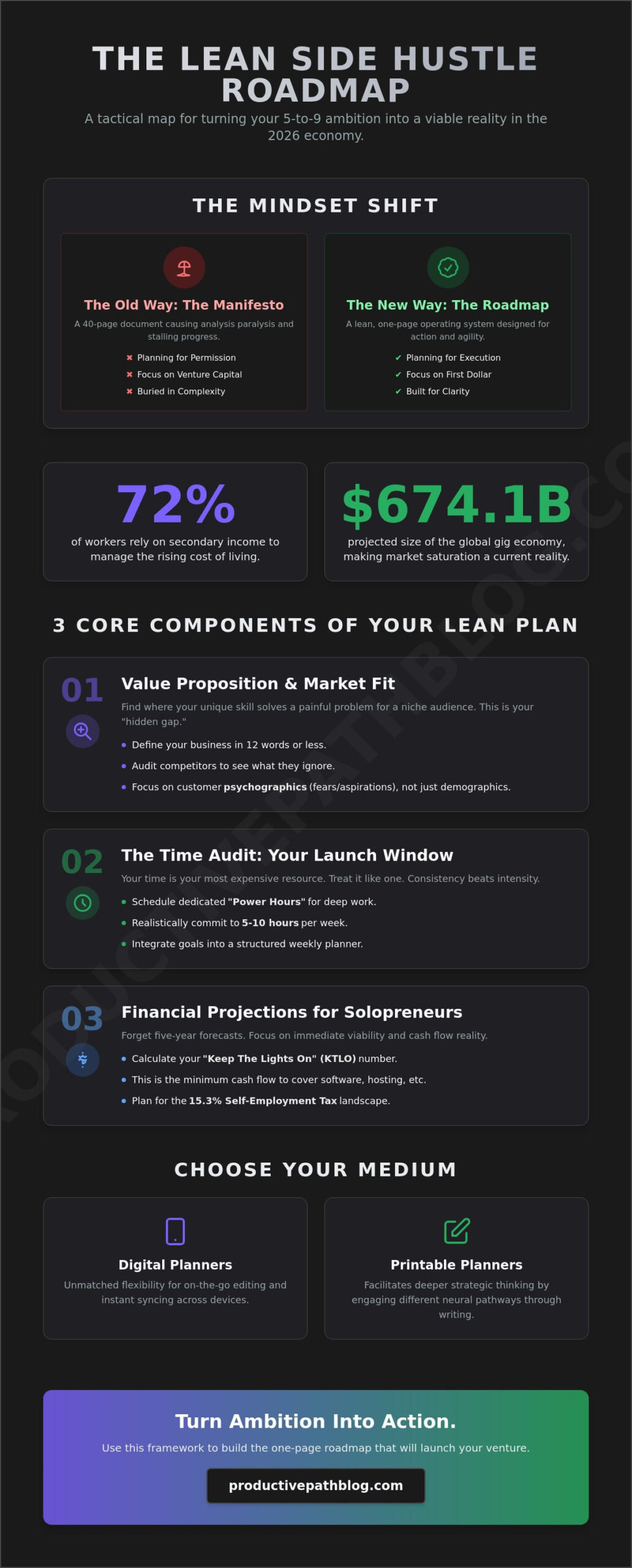
We understand that 72% of workers now rely on secondary income to manage the rising cost of living. You need clarity, not complexity. This article promises to help you master the transition from dreamer to founder with a lean, actionable framework built for the 2026 economy. We’ll explore how to validate your idea, track your daily progress, and navigate the 15.3% self-employment tax landscape. By the end, you’ll have a one-page roadmap that turns your ambition into a disciplined, viable reality.
Key Takeaways
- Understand why a lean, strategic roadmap is more effective than a traditional business plan for managing a high-growth side venture.
- Identify the essential elements of a high-impact side hustle business plan template, from uncovering market gaps to defining customer psychographics.
- Overcome the trap of analysis paralysis by learning how to distill complex strategies into actionable, daily tasks.
- Discover how to integrate your business goals into your existing schedule using structured weekly planner templates.
- Shift your mindset from passive saving to active strategic growth by building an organizational foundation that supports scaling.
What is a Side Hustle Business Plan Template?
The 2026 economic landscape demands a shift in how we approach new ventures. With the global gig economy projected to hit $674.1 billion this year, market saturation is no longer a distant threat. It’s a current reality. Starting a venture today requires more than just a good idea; you need a side hustle business plan template that prioritizes agility over bureaucracy. This isn’t about writing a manifesto. It’s about building a tactical operating system that survives the transition from your 9-to-5 to your 5-to-9.
Unlike a traditional document designed to impress a bank manager or a group of investors, this template is a lean, strategic roadmap. While the standard What is a Business Plan? often focuses on securing venture capital or institutional loans, the side hustle framework is about “Planning for Execution” rather than “Planning for Permission.” You don’t need an outside authority to validate your vision. You need a system that ensures your limited hours are spent on high-leverage activities that move the needle. A side hustle business plan template serves as the bridge between your current professional life and your future as a founder.
The Core Purpose: Why Templates Save Time
Staring at a blank cursor is the fastest way to kill a dream. Templates act as a psychological bridge, moving you from the abstract “what if” to the concrete “how to.” They eliminate “blank page syndrome” by providing the necessary scaffolding for your thoughts. In 2026, the Lean Side Hustle methodology has become the industry standard. This approach focuses on rapid validation and minimal overhead. Having a structured path doesn’t just save time; it preserves your mental energy for the tasks that actually generate revenue. Structure breeds confidence.
Digital vs. Printable: Choosing Your Medium
The medium you choose for your plan dictates how you interact with your goals. Digital planner templates offer unmatched flexibility for the modern entrepreneur. They allow for on-the-go editing and instant syncing across devices, making them ideal for the fast-paced nature of digital markets. However, we shouldn’t overlook the cognitive benefits of tactile planning. Printable planner pages often facilitate deeper strategic thinking. The physical act of writing engages different neural pathways; it helps you process complex problems more effectively than clicking through endless browser tabs. Instant-access downloads ensure you can move from inspiration to implementation without the friction of a shipping delay.
Core Components: What Actually Belongs in Your Side Hustle Template
A side hustle isn’t a miniature corporation; it’s a specialized operation. While official SBA guidelines provide a robust foundation for general ventures, a side hustle business plan template must account for the scarcity of your most valuable asset: time. It needs to be lean. It needs to be actionable. Every section should serve a single purpose: moving you closer to your first dollar without sacrificing your sanity or your primary career.
The Value Proposition and Market Fit
Can you define your business in 12 words or less? If you can’t, your concept is likely too complex for a part-time venture. In the crowded 2026 creator economy, Market Fit is the precise intersection where your unique skill set solves a specific, painful problem for a niche audience. Use digital tools to audit competitors and identify what they’re ignoring. Your value proposition isn’t just what you sell; it’s the “hidden gap” in the market that you’re uniquely qualified to fill. Focus on psychographics, such as your customer’s fears and aspirations, rather than just basic demographics like age or location.
The Time Audit: Designing Your Launch Window
Time is your most expensive resource. Most side hustlers fail because they treat their venture like a hobby, working only “when they feel like it.” You need “Power Hours.” These are dedicated blocks of deep work scheduled within your weekly planner template to ensure progress doesn’t stall. Mapping out your week allows you to find hidden pockets of productivity. If you can only commit 5 to 10 hours per week, your milestones must reflect that reality. Don’t plan for a 40-hour work week when you only have five. Consistency beats intensity every time.
Financial Projections for Solopreneurs
Forget complex balance sheets and five-year forecasts. Focus on your “Keep the Lights On” (KTLO) number. This is the absolute minimum cash flow required to cover your software, hosting, or material costs. Identifying these startup costs early prevents financial leaks. With 53% of side hustlers relying on their extra income to cover essential expenses, accuracy is vital. Set a clear 90-day profit goal to validate your business idea. If you haven’t seen a return on your investment within three months, it’s time to audit your methods and pivot. This disciplined approach ensures you aren’t just spending money on a glorified hobby.
Strategy vs. Action: Why Most Traditional Business Plans Fail Side Hustlers
“I don’t have time to write a plan.” It’s the most common refrain among new entrepreneurs, and frankly, it’s often justified. Traditional planning methods were built for corporations seeking millions in capital, not for individuals trying to launch a service after their kids go to bed. When you spend weeks drafting a 40-page document, you aren’t building a business; you’re procrastinating. This is the analysis paralysis trap. A modern side hustle business plan template avoids this by prioritizing action over theory. It moves you from the “dreamer” phase to the “founder” phase without the unnecessary friction of corporate bureaucracy.
Instead of static planning, we embrace iterative growth. Your business isn’t a fixed path. It’s a series of controlled experiments designed to test your assumptions in the real world. While academic resources offer a solid step-by-step guide for general business structures, your side hustle needs to move faster. You need to test, learn, and adjust in real-time. Static documents gather dust. Iterative plans generate revenue.
The Complexity Trap
Forty-page business plans are the primary killer of side hustles. They create a false sense of progress while keeping you away from your actual customers. A “One-Page Framework” is superior because it forces you to be concise. It forces you to make decisions. Every sentence in your plan must be audited for fluff. Ask yourself: does this sentence lead directly to revenue or customer acquisition? If the answer is no, delete it. Your side hustle business plan template should be a lean engine, not a heavy anchor that prevents you from setting sail.
Pivot-Ready Planning
Markets shift. Consumer habits change. In 2026, the speed of these shifts has accelerated due to rapid AI integration and digital platform volatility. Your plan must be pivot-ready. By using a quarterly planner template, you can re-evaluate your goals every 90 days. This cycle allows you to “fail fast” without losing your momentum. If a particular service isn’t gaining traction, the data in your plan helps you see it clearly so you can shift your focus. Flexibility is your greatest strategic advantage. It transforms a rigid document into a living, breathing guide for active growth.
Implementation Guide: How to Integrate Your Plan into Your Daily Workflow
A strategy without execution is just a daydream. The most sophisticated side hustle business plan template becomes a liability if it doesn’t inform your daily actions. Integration is the final hurdle. It’s the difference between a hobbyist and a founder. To succeed in the 2026 market, you must treat your plan as a living document that dictates how you spend every spare hour of your week. It isn’t enough to have a roadmap; you have to actually drive the car.
Start by distilling your overarching vision into three core monthly objectives. This prevents the psychological overwhelm that kills most new ventures. Next, use a weekly planner template to assign specific tasks to specific days. Don’t leave your progress to chance. Each morning, audit your daily to-do list against your business plan goals. If a task doesn’t serve an objective, cut it. Every Sunday, schedule a “Sunday Strategy Session” to reflect on your progress. Finally, adjust your financial targets based on real-time data. Remember that for 2026, the self-employment tax rate is 15.3% on your first $184,500 of earnings. If your marketing isn’t hitting the 90-day profit goals we discussed earlier, pivot immediately.
From Strategic Goal to Daily Task
The “Waterfall Method” is your best tool for clarity. It involves taking one high-level goal and breaking it down into five small, manageable daily tasks. This ensures you never sit down to work and wonder what to do next. Time-blocking templates are essential here; they protect your side hustle hours from the encroachment of your 9-to-5 or personal life. For a deeper dive into these systems, explore How to Organize Your Side Hustle: A Strategic Framework for 2026.
Tracking Progress and ROI
Consistency is the engine of growth. Use habit trackers within your planner to ensure your marketing efforts remain steady, even when motivation dips. Recording “Small Wins” is equally important; it provides the psychological fuel needed to sustain a venture over the long haul. Data-driven reflection in a digital planner ensures your decisions are based on evidence rather than emotion. By tracking your return on investment daily, you stay lean and agile. This disciplined approach transforms your side hustle business plan template from a static file into a powerful tool for active strategic growth.
Ready to stop dreaming and start building? Download our premium planner templates to bridge the gap between strategy and execution today.
Scaling Your Vision with Productive Path Planner Templates
Strategy is the seed, but organization is the soil. At the Productive Path Blog, we operate under a singular philosophy: Organization is the Foundation of Growth. You can have the most brilliant side hustle business plan template in the world, but without a system to house those ideas, they remain fragile. Growth doesn’t happen by accident. It happens through the disciplined application of your strategy to your daily life. Our mission is to provide the architectural framework that supports your transition from a dreamer to a disciplined founder.
Execution requires tools that match your ambition. We provide instant-download planner templates designed specifically for the high-stakes environment of the modern side hustler. These aren’t generic calendars. They’re strategic instruments built to help you prioritize high-leverage tasks while managing a full-time career. By integrating your business plan directly into your daily workflow, you eliminate the friction between “thinking” and “doing.” We invite you to browse our collection of digital and printable solutions to find the system that fits your unique rhythm.
Designed for the Modern Entrepreneur
Our goal-setting planner templates go beyond simple to-do lists. They include dedicated sections for tracking your “Keep the Lights On” numbers and auditing your “Power Hours,” as we discussed in earlier sections. The minimalist design isn’t just an aesthetic choice; it’s a strategic one. By reducing visual noise, we help you focus on the deep work that actually moves the needle. Because life is unpredictable, our templates are undated. This provides the flexibility you need to scale your venture at your own pace without the guilt of wasted pages or missed weeks.
Your Strategic Partner in Productivity
The Productive Path Blog is more than a template shop. We’re your visionary partner in the quest for active strategic growth. We see beyond surface-level productivity hacks to identify the underlying systems that create long-term success. It’s time to stop treating your venture like a hobby and start treating it like the future engine of your financial freedom. Transform your side hustle from a flickering dream into a profitable reality by adopting a system built for execution. Visit our shop today to download the tools you need to implement your side hustle business plan template with precision and confidence.
Building Your Future Beyond the 9-to-5
The transition from a passive saver to an active founder requires more than just ambition. It demands a disciplined framework. By moving away from bloated, traditional planning and adopting a lean side hustle business plan template, you reclaim your most valuable asset: time. Success in 2026 isn’t about having the most complex manifesto. It’s about having the most consistent execution. Your strategy must be a living tool, integrated into your daily habits and audited against real-world data to ensure your venture remains viable and profitable.
Organization is the bridge between a dream and a sustainable venture. We’ve helped thousands of digital organizers find their rhythm through professional layouts designed specifically for ROI. If you’re ready to stop the cycle of information overload and start seeing tangible results, it’s time to equip yourself with the right systems. Browse our Strategic Planner Templates for Side Hustlers to access instant-access digital downloads that turn your high-level vision into daily progress. Don’t wait for permission to build the life you want. The tools are ready; the strategy is clear. Now, it’s your turn to execute.
Frequently Asked Questions
Do I really need a business plan for a small side hustle?
Yes, you absolutely need a plan, but it shouldn’t be a 40-page burden. A lean side hustle business plan template acts as a strategic filter. It helps you say “no” to distractions that don’t lead to revenue. Without this structure, you’re likely to treat your venture as a hobby rather than a scalable business. Clarity is the foundation of growth.
What is the difference between a business plan and a marketing plan?
A business plan is your comprehensive strategic roadmap, while a marketing plan is the specific engine used to drive traffic. Think of the business plan as the “what” and “why” of your operation. It covers finances and market fit. The marketing plan focuses strictly on “who” your customers are and “how” you’ll reach them via digital platforms or social media.
How often should I update my side hustle business plan?
You should audit your plan every 90 days to maintain agility in a volatile market. Static documents are useless in the 2026 creator economy. A quarterly review allows you to check your progress against your initial assumptions and pivot if necessary. This iterative approach ensures that your daily tasks still align with your long-term financial goals.
Can I use a digital planner template on my iPad for business planning?
Absolutely. Using a digital side hustle business plan template on an iPad offers the perfect blend of mobility and organization. Digital templates allow for instant syncing across devices, ensuring you can capture insights during a lunch break or commute. This flexibility is essential for entrepreneurs balancing a full-time career with a growing venture.
What are the most important financial metrics for a side hustler to track?
Focus on your “Keep the Lights On” (KTLO) number and your net profit margin. You must track every dollar spent on software or materials to ensure your venture is actually viable. Understanding your cash flow is more important than complex balance sheets. Remember that you’re required to pay self-employment tax if your net earnings reach $400 or more.
How do I balance a 9-to-5 while following a business plan?
Success lies in “Power Hours” and strict time-blocking. You must protect small pockets of your day to execute the tasks outlined in your plan. Audit your daily to-do list every morning to ensure you aren’t wasting time on fluff. By assigning specific objectives to specific days, you transform a daunting goal into a series of manageable, daily actions.
What should I do if my business plan isn’t working after three months?
Analyze the data and pivot. If your 90-day profit goals aren’t met, it’s a signal that your current value proposition or marketing strategy isn’t resonating. Don’t view this as a failure; view it as a necessary market correction. Use your plan to identify exactly where the friction is occurring, then adjust your methods to better fit the current market gaps.
Are printable planner pages better than digital ones for brainstorming?
Printable planner pages offer a tactile advantage for deep strategic thinking and brainstorming. The physical act of writing engages different neural pathways, helping you process complex ideas more effectively than digital typing. Many founders use printable pages for their “Sunday Strategy Sessions” and then transfer those finalized tasks into a digital planner for daily execution and tracking.